
Established medical practices typically spend 5–10% of gross revenue on marketing. New practices, or those actively growing, commonly invest 10–15%. In dollar terms, that lands most single-location practices between $3,000 and $8,000 per month.
Percentages are a starting frame, not an answer. What follows is how to convert that into a real budget: what your specialty implies, how to split the money across channels, and the one constraint that should cap your spending regardless of the math.
How Do You Set a Marketing Budget as a Percentage of Revenue?
Start with gross revenue, apply a percentage based on your stage, then sanity-check the result against your growth goal.
- Established, stable practice, defending position: 5–7% of gross revenue.
- Established practice pursuing growth: 8–10%.
- New practice, or entering a new market/service line: 10–15%.
- Competitive elective specialty: often 12–15%, because you are creating demand rather than capturing it.
A practice doing $2M annually and holding steady sits around $8,000–$12,000 monthly. The same practice opening a second location moves toward $16,000–$25,000 during the launch phase, then settles back.
The percentage approach fails in one common case: a practice with revenue too low to fund meaningful marketing. If 10% of your revenue is $1,200 a month, percentage-based budgeting will keep you stuck. In that situation, budget from the goal instead — decide how many new patients you need, multiply by a realistic acquisition cost, and fund that number even if it exceeds the percentage.
Want this calculated for your practice? Request a budget plan for your specialty — we’ll model your target patient volume, realistic acquisition costs, and a month-by-month allocation.
Marketing Budget Benchmarks by Specialty
| Specialty | Typical Monthly Budget | Why It Sits Here |
|---|---|---|
| Family practice / primary care | $2,500–$6,000 | Insurance-driven, local capture, high volume and modest per-patient value |
| Dental (general) | $3,000–$8,000 | Saturated local competition inside a small radius |
| Dermatology / aesthetics | $8,000–$25,000 | Elective, cash-pay, high lifetime value, heavy paid competition |
| Mental health / therapy | $2,000–$8,000 | Strong organic demand; ad policy restrictions limit paid options |
| Addiction treatment | $10,000–$50,000+ | Extreme CPCs plus LegitScript certification requirements |
| Physical therapy / rehab | $2,500–$7,000 | Direct-access patients plus physician referral development |
| Cardiology | $4,000–$12,000 | Mixed referral and direct-to-patient; wider catchment area |
| Senior care / assisted living | $5,000–$15,000 | Long decision cycles, adult-child decision makers, occupancy-driven |
| Multi-location group / MSO | $15,000–$100,000+ | Per-location local coverage plus centralized program management |
Ranges reflect typical U.S. market rates in 2026 and vary substantially by metro competitiveness.
How Should You Allocate the Budget Across Channels?
A reasonable default split for an established single-location practice:
- SEO and content — 30–40%. The compounding asset. Cut this last; it takes months to rebuild.
- Paid search — 25–35%. Immediate volume and the fastest lever when the schedule has gaps.
- Website and conversion — 10–15%. Ongoing improvements to speed, booking, and page conversion. Underfunding this makes every other channel more expensive.
- CRM, email, and reactivation — 10–15%. The cheapest patients you will ever acquire, and the most commonly skipped line.
- Reputation and reviews — 5–10%. Systematized requests and response management.
- Analytics and attribution — 5%. Small line, disproportionate effect: it’s what tells you which of the above to scale.
Two adjustments worth making. New practices should weight paid search higher early (40–50%) because SEO hasn’t matured yet. Practices with strong organic rankings and a full schedule should shift toward CRM and reactivation, which raise revenue without adding new demand.
For multi-location groups, split the budget into two pools rather than dividing evenly. A central pool funds work that benefits every location at once — technical SEO, content production, brand, and reporting infrastructure. A per-location pool funds Google Business Profile management, local reviews, and geo-targeted ads for each site. Newer or underperforming locations should draw more from the local pool than mature ones, which is impossible to do sensibly if the budget is simply divided by location count.
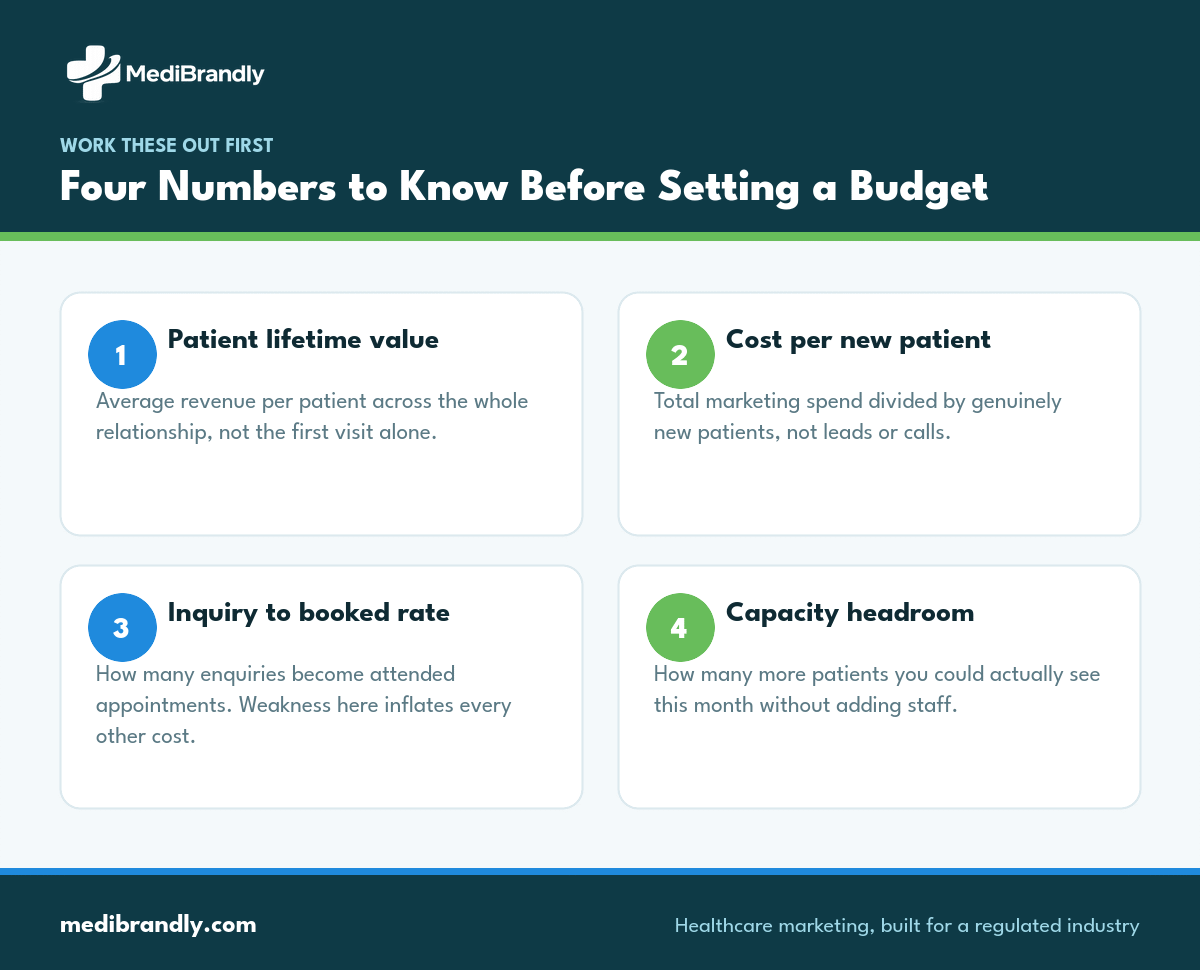
The Capacity Rule: Don’t Buy Demand You Can’t Serve
This is the constraint most budget guides omit, and the one that wastes the most money.
Marketing spend should be capped by your ability to convert and serve the demand it creates. If your front desk misses a third of inbound calls, if the next available appointment is six weeks out, or if nobody follows up on form fills within the day, additional spend buys you leads that decay before they become patients.
Before increasing budget, check three things:
- Answer rate. What percentage of inbound calls are actually answered live during business hours?
- Speed to lead. How long between a form submission and a human response? Beyond a few hours, conversion falls sharply.
- Availability. How far out is your next new-patient slot? If it’s weeks, more demand mostly generates no-shows and cancellations.
Fixing those three usually produces more patients than a budget increase would — and costs far less. A practice losing 30% of inbound calls is effectively burning 30% of its marketing budget, whatever the number is. This is why we treat CRM and follow-up automation as budget infrastructure rather than an optional add-on.
Not sure whether to spend more or fix conversion first? That’s the first thing we assess. Book a free strategy consultation → and we’ll tell you honestly which one your practice needs.
How Budgets Should Change as a Practice Matures
Launch (months 0–12). Highest percentage of revenue, weighted to paid search and foundational build. You are buying visibility you don’t yet have organically. Expect 12–15%.
Growth (years 1–3). SEO begins carrying load, so the paid share falls while total spend often rises. Content and local authority compound. Around 10%.
Established (year 3+). Shift toward retention, reactivation, and defending rankings. Percentage drops to 5–8% while absolute dollars may hold steady as revenue grows.
Expansion. Each new location or service line temporarily resets you to launch economics for that location, layered on top of the existing program.
The mistake to avoid is cutting marketing to established-practice levels before you’ve built established-practice rankings. Practices that reduce spend at month eight — right before SEO typically matures — routinely lose the investment they already made. For the full channel-by-channel cost picture, see our healthcare marketing cost breakdown; for SEO specifically, the healthcare SEO cost guide.
If you’d rather build this around your actual numbers than benchmarks, that’s a strategy and consulting exercise.
Five Budgeting Mistakes That Waste the Most Money
Treating marketing as a discretionary expense. Budgets that get cut whenever revenue dips produce start-stop programs that never compound. Rankings decay, ad accounts lose learning, and each restart pays the ramp-up cost again. Set a floor you will not go below.
Funding channels but not measurement. Spending $8,000 a month with no call attribution means you are guessing which half works. The analytics line is the smallest in the budget and the one that makes every other line accountable.
Ignoring retention. Acquiring a new patient costs several times more than reactivating a dormant one. Practices with no recall or reactivation program are buying expensive patients while cheap ones sit unused in the database.
Spreading too thin. A $3,000 budget split across SEO, paid search, social, email, video, and print does none of them properly. At smaller budgets, concentration beats coverage — pick the two channels that fit your specialty and fund them adequately.
Budgeting for leads instead of patients. Lead volume is easy to buy and easy to inflate. The only number that governs whether a budget is working is cost per booked, attended appointment measured against lifetime value.
Frequently Asked Questions
What percentage of revenue should a medical practice spend on marketing?
Established practices typically spend 5–10% of gross revenue; new or growth-stage practices invest 10–15%. Competitive elective specialties such as dermatology and aesthetics often sit at the top of those ranges.
How much should a new medical practice budget for marketing?
Plan for 10–15% of projected revenue, weighted toward paid search and website foundations. In dollars, most new single-location practices invest $2,500–$6,000 per month during the first year.
Is it better to spend on SEO or paid ads?
Both, with the mix shifting over time. Paid search produces patients immediately but stops when spending stops; SEO takes four to six months but compounds and lowers long-term acquisition cost. New practices weight paid; mature practices weight organic.
How do I know if my marketing budget is working?
Track cost per acquired patient against patient lifetime value, using call tracking and form attribution tied to booked appointments. If your reporting stops at traffic, rankings, or impressions, you cannot answer this question.
Should I cut marketing when the schedule is full?
Rarely cut it entirely — rankings and momentum decay. Instead redirect spend toward retention, reactivation, and higher-value service lines, and consider whether capacity should expand.
How much does a marketing agency cost versus hiring in-house?
A capable in-house marketer costs $60,000–$100,000+ annually plus tools, and one person rarely covers SEO, paid, design, automation, and compliance. Most practices under ten locations get broader capability from a specialist agency at similar or lower total cost.
Get a Budget Built Around Your Numbers
Benchmarks tell you whether you’re in a normal range. They don’t tell you what your practice should spend to hit a specific growth target in your specific market.
We’ll model your patient goals against realistic acquisition costs, check whether your conversion process can handle the volume, and return a month-by-month allocation you can hold any agency accountable to.
Request your specialty budget plan → or email info@medibrandly.com. You can also explore strategy and consulting or see outcomes in our case studies.