
Most medical practices pay $3–$30 per click on Google Ads, with cost per acquired patient typically landing between $150 and $600. Addiction treatment and competitive elective specialties run far higher, sometimes $50–$150+ per click.
Those spreads are driven almost entirely by specialty and market. Below are the benchmarks by specialty, the platform changes that matter in 2026, and how to work backwards from a booked appointment to a defensible budget.
What Does a Click Cost by Specialty?
Cost per click reflects what a patient is worth to your competitors. Where lifetime value is high and cash-pay, bidding is fierce.
| Specialty | Typical CPC | Typical Cost Per Lead | What Drives It |
|---|---|---|---|
| Family practice / primary care | $3–$12 | $40–$120 | Insurance-driven, high volume, modest per-patient value |
| Physical therapy / rehab | $5–$15 | $50–$150 | Direct access plus referral competition |
| Dental — general | $6–$20 | $60–$200 | Dense local competition inside a small radius |
| Dental — implants / ortho | $15–$40 | $150–$450 | Case values in the thousands |
| Cardiology | $8–$20 | $80–$250 | Wider catchment, mixed referral and direct |
| Mental health / therapy | $8–$25 | $70–$220 | Strong demand, but ad policy limits targeting |
| Dermatology / aesthetics | $10–$30 | $100–$350 | Elective, cash-pay, heavy paid competition |
| Senior care / assisted living | $10–$30 | $150–$500 | Long decision cycles, high contract value |
| Addiction treatment | $50–$150+ | $500–$2,000+ | Extreme admission value plus certification barriers |
Ranges reflect typical U.S. auction conditions in 2026 and vary widely by metro. Treat them as planning anchors, not quotes.
Already running ads and unsure they’re profitable? Request a free PPC account audit — we’ll review your wasted spend, conversion tracking, and policy exposure, and show you what your true cost per booked patient is.
What Changed in Google Ads for Healthcare in 2026?
Three shifts matter more than the rest.
Enforcement got slightly less brutal. Under an April 2026 update to the Healthcare and Medicines policy, violations no longer trigger immediate suspension without notice — Google states it will issue a warning at least seven days beforehand. That is meaningful breathing room for practices who previously lost accounts overnight, but it is not permission to be careless.
Local Services Ads opened up to healthcare. Local Services Ads now cover a range of health categories including dentists, dermatologists, optometrists, pediatricians and general practitioners. They sit above traditional search ads, carry a verification badge, and bill per lead rather than per click. Availability varies by location and category, so eligibility is worth rechecking even if you were excluded a year ago.
Campaign automation went keywordless. Performance Max and, more recently, AI Max for Search have moved the platform away from advertiser-chosen keywords toward AI-matched queries. This has direct compliance consequences for healthcare, which the next section covers.
Should Healthcare Advertisers Turn On AI Max?
Cautiously, and never on the whole account at once.
AI Max for Search is not a new campaign type. It’s a layer added to existing Search campaigns that does two things: it expands beyond your keywords using keywordless matching, and it optimizes assets — including Final URL expansion, which lets Google choose a different landing page than the one you specified.
Both features are genuinely useful in ordinary industries. In healthcare they carry specific risks:
- Keywordless matching can surface your ads on conditions you don’t treat, or on symptom queries where the implied claim is one you cannot substantiate.
- Final URL expansion can send a regulated query to a page without the right disclaimers, or to a page that was never written to be a landing page at all.
- Automated text customization can generate copy you didn’t approve, which is a problem when claim language is legally constrained.
The workable approach is to pilot it on one non-sensitive campaign — routine services rather than conditions — with Final URL expansion disabled, brand and competitor exclusions in place, and a genuinely comprehensive negative keyword list. Then read the search terms report weekly. If automation is matching queries you would never have bid on, that’s the signal to pull back.
What Does Google’s Healthcare Policy Restrict?
Google’s Healthcare and Medicines policy governs what medical advertisers may promote, and the restrictions are category-specific rather than universal.
The clearest example is addiction treatment. Recovery-oriented drug and alcohol services are restricted, and advertisers generally must hold LegitScript certification before they can run ads in the U.S. and Canada — certification that also clears the way for Meta and Microsoft advertising. Certification takes time and money, and it is the single biggest barrier to entry in that vertical. It is also why addiction treatment CPCs stay so high: the field of eligible bidders is deliberately small.
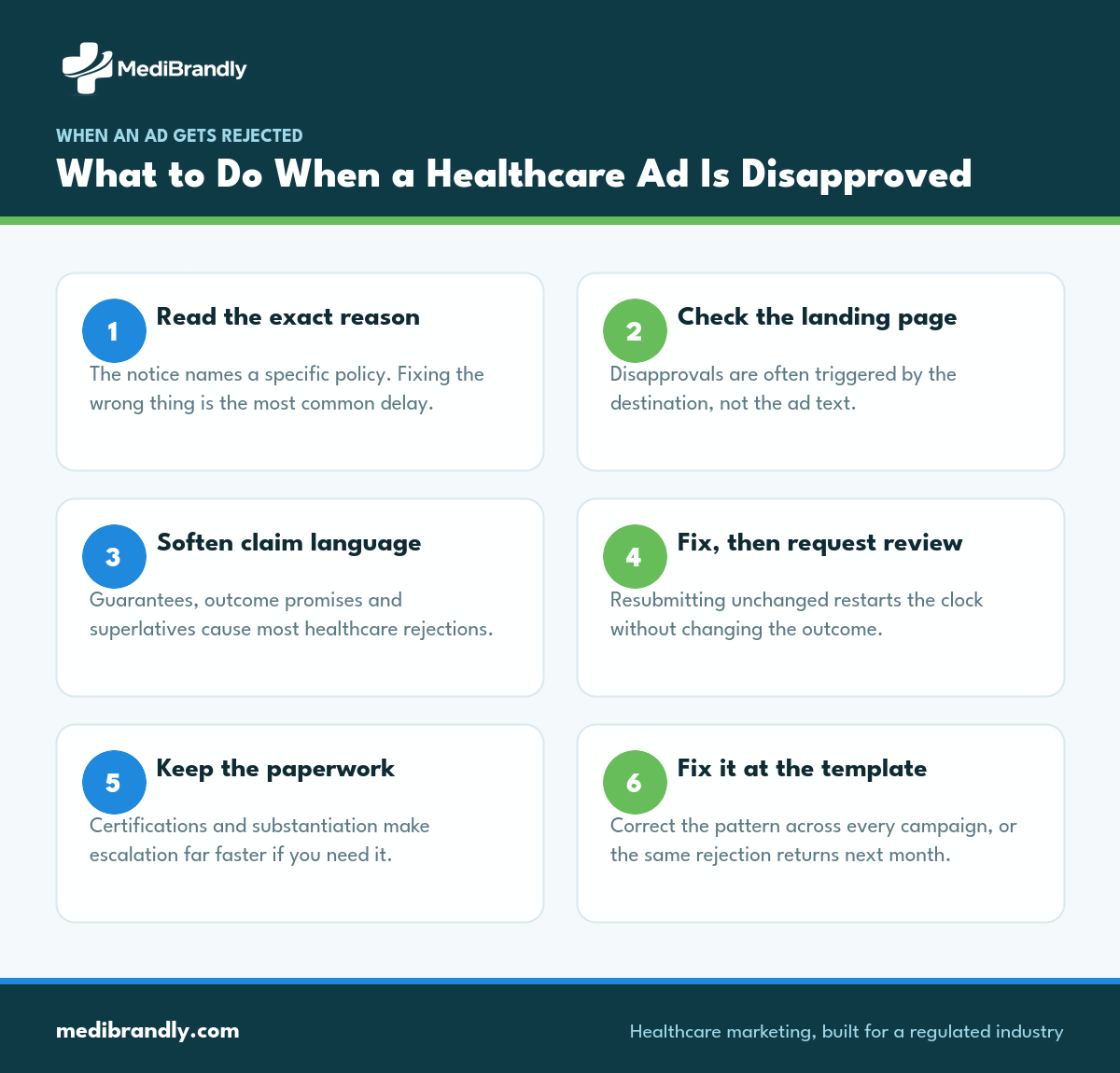
Other categories carry their own constraints around prescription drugs, restricted drug terminology and certain treatment claims. The practical rule for any practice: assume the claim language in your ads is held to a higher standard than in other industries, and never let “results” language into a headline without a substantiation trail behind it.
Running ads in a restricted category? MediBrandly builds compliant campaign structures for regulated specialties — from certification support to landing pages that survive review. Book a free strategy consultation →
How to Work Backwards From a Booked Patient to a Budget
Most practices budget forwards (“we’ll try $2,000”) and then can’t tell whether it worked. Do it in reverse:
- Start with patient lifetime value. What is a new patient genuinely worth across the relationship, not on the first visit?
- Decide an acceptable acquisition cost. A common ceiling is 10–20% of lifetime value. For a $2,000 patient, that’s $200–$400.
- Apply your booking rate. If 40% of leads become booked, attended appointments, a $300 patient target means you can afford roughly $120 per lead.
- Apply your landing page conversion rate. At a 10% conversion rate, $120 per lead means about $12 per click is your ceiling.
- Compare that to your specialty’s CPC. If your ceiling is $12 and your market’s CPC is $25, ads will not work until conversion rate or lifetime value improves — that’s a math problem, not a bidding problem.
This is also why measurement is not optional. Without call tracking and form attribution tied to booked appointments, every number above is a guess. Building that measurement without exposing patient data is the job of HIPAA-safe analytics, and the constraints are covered in our HIPAA marketing rules guide.
Where Healthcare Ad Budgets Leak Most
Before adding budget, it is usually cheaper to stop the losses. Four recur in almost every healthcare account we audit.
Job-seekers and students. Searches like “dental hygienist salary” or “physical therapy programs” burn budget daily. A negative keyword list containing jobs, careers, salary, training, school, courses and certification pays for itself immediately.
Existing patients. Branded searches from people who already booked look like conversions but create no new revenue. Segment brand into its own campaign so you can see the difference.
Out-of-area clicks. Radius targeting set too wide, or left on “presence or interest,” attracts people who will never travel to you. Set targeting to presence only.
Off-hours calls nobody answers. Ads running at 9pm generate calls into voicemail. Either schedule ads to staffed hours or route after-hours calls somewhere that answers.
Why Landing Pages Decide Your Real Cost
Two practices can bid identically and pay completely different costs per patient, because cost per click is only half the equation.
A landing page that converts at 12% instead of 5% cuts your cost per lead by more than half without touching a single bid. In healthcare, the elements that move that number are consistent: a headline matching the ad’s promise, insurance and cost information answered plainly, visible phone number, online booking above the fold, real photos of the practice, and a form that asks for the minimum necessary.
The compliance overlay matters too. Forms handling patient information need appropriate safeguards, and any tracking on the page must not leak that information to ad platforms. This is where a general PPC agency and a healthcare paid search specialist diverge sharply.
Are Google Ads Worth It for Doctors?
Usually yes, with two honest caveats.
Ads are the fastest lever available: a well-built campaign produces booked appointments within days, which is why new practices and practices with schedule gaps lean on them. They are also the most expensive per patient over the long run, because the moment you stop paying, the flow stops.
The caveats. First, ads amplify whatever your conversion process already is — a practice that misses inbound calls will simply pay to miss more of them. Second, ads do not compound. A dollar spent on paid search buys one patient; a dollar spent on SEO builds an asset that keeps producing. Most healthy programs run both, weighted toward paid early and rebalanced as organic matures. For the full channel picture, see our healthcare marketing cost breakdown.
Frequently Asked Questions
How much do Google Ads cost for doctors?
Most practices pay $3–$30 per click, producing leads at $40–$500 depending on specialty and market. Addiction treatment sits far above that range, commonly $50–$150+ per click, because admission values and certification barriers concentrate the auction.
How much should a medical practice spend on Google Ads monthly?
A meaningful starting budget for a single location is $2,000–$10,000 per month in ad spend, plus 15–25% for management. Competitive elective and behavioral health specialties generally need substantially more to hold position.
Do I need LegitScript certification to advertise?
For addiction treatment services in the U.S. and Canada, generally yes. Certification is required by Google before running those ads, and it also permits advertising on Meta and Microsoft. Most other medical specialties do not require it.
Is AI Max safe for healthcare advertisers?
It can be, with guardrails. Pilot it on non-sensitive campaigns, disable Final URL expansion, maintain a thorough negative keyword list, and review search terms weekly. The risk is automation matching queries or landing pages you would not have chosen in a regulated category.
Can medical practices use Local Services Ads?
Increasingly yes. Local Services Ads now cover health categories including dentists, dermatologists, optometrists, pediatricians and general practitioners, billing per lead rather than per click. Eligibility varies by location, so check even if you were previously excluded.
Google Ads or SEO — which should a practice fund first?
Fund ads first if you need patients this quarter, and SEO in parallel if you want lower acquisition costs later. Ads stop producing when spending stops; SEO takes four to six months but compounds. The mix should shift toward organic as rankings mature.
Find Out What You’re Actually Paying Per Patient
Most accounts we audit are not failing because of bidding. They’re failing because conversions are mistracked, automation is matching the wrong queries, or the landing page is losing patients the ads already paid for.
We’ll review your campaign structure, search terms, conversion tracking, and policy exposure, then show you your real cost per booked patient and where the waste is.
Request your free PPC account audit → or email info@medibrandly.com. You can also review our healthcare paid search services or see outcomes in our case studies.