
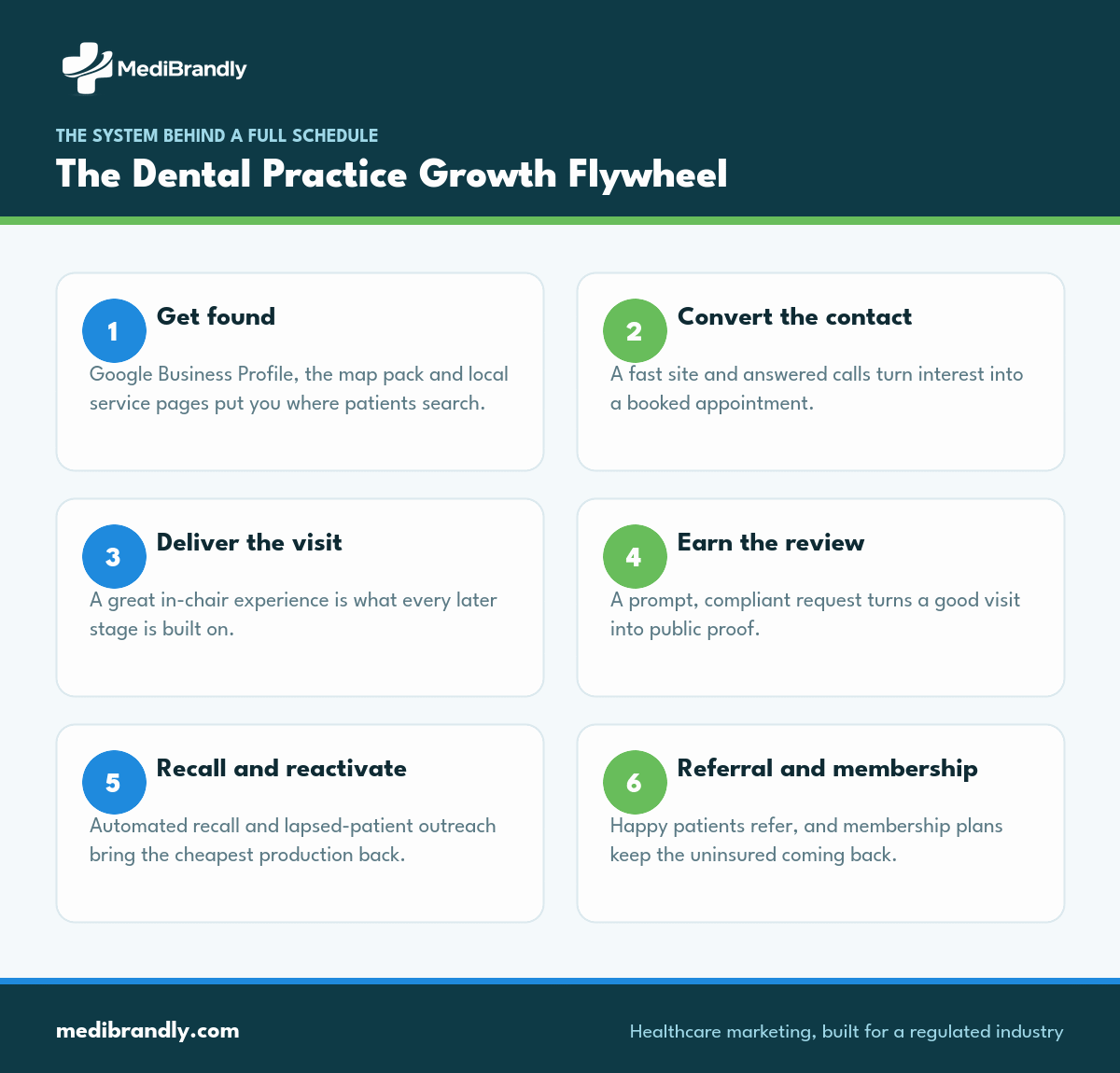
The dental marketing that books appointments in 2026 isn’t a clever campaign — it’s a system: get found locally, convert the calls you already get, and reactivate the patients you already have. Most practices chase new leads while quietly leaking the two cheapest sources of production they own.
This playbook ranks ideas by return, not novelty. Start at the top — the fundamentals that compound — before spending a dollar on anything lower down.
What Dental Marketing Actually Delivers the Best ROI?
The highest-ROI dental marketing is almost always local search visibility and reactivation of existing and lapsed patients — because both reach people already close to booking, at a fraction of the cost of chasing strangers. New-patient advertising matters, but it’s rarely where the best return hides.
Think in three tiers: own your local presence, convert what you already generate, and reactivate who you already have. Only after those are running well does aggressive new-patient acquisition pay off. For where this sits in the wider picture, see our dental SEO pricing guide and how to get more patients.
Not sure which ideas will move your schedule? Request a free dental marketing audit — we’ll show you where your new patients come from now, where you’re leaking appointments, and the three changes that would fill your schedule fastest.
18 Dental Marketing Ideas Ranked by Return
Work top to bottom. The first several are foundational and compound; the later ones amplify once the basics are in place.
- Optimize your Google Business Profile — the single biggest local lever for a dental practice.
- Build a fast, mobile-first website that answers cost and insurance questions plainly.
- Earn Google reviews consistently and compliantly — recency drives both ranking and choice.
- Rank for local service terms — implants, Invisalign, emergency dentist, in your city.
- Fix your call handling — most missed production is an unanswered or fumbled phone call.
- Run recall and reactivation campaigns to bring lapsed patients back automatically.
- Use Local Services Ads (LSAs) where available to appear above the map pack with pay-per-lead economics.
- Create individual treatment pages — one per high-value service, not a single “Services” page.
- Set up online booking so an interested patient can act at 10pm without calling.
- Market your membership plan to uninsured patients as an accessible alternative.
- Send appointment reminders and confirmations to cut no-shows, your quietest revenue leak.
- Ask for referrals systematically rather than hoping happy patients mention you.
- Publish patient-education content that answers the questions people search before booking.
- Show real before-and-after cases — with documented patient consent, never without.
- Run targeted paid search for high-value, high-intent procedures once the basics convert.
- Keep NAP citations consistent across directories so local signals stay strong.
- Use email for treatment-plan follow-up on unscheduled recommended care.
- Build a simple social presence that reassures rather than tries to go viral.
Which Ideas Should I Skip?
Skip anything that buys reach without a system to convert it — most “boosted” social posts, mass discount coupons that attract one-time price shoppers, and vanity metrics like follower counts. They feel like marketing but rarely reach the schedule.
The pattern to avoid: spending on the top of the funnel while the bottom leaks. A discount blast that drives calls nobody answers, to a site that doesn’t explain cost, is money spent to expose a broken process. Fix conversion and retention before you widen the net.
What Does Recall and Reactivation Actually Look Like?
Recall is the automated, ongoing outreach that brings patients back for regular care; reactivation targets those who’ve lapsed. Together they’re the cheapest production a practice can generate, because these people already know and trust you.
The mechanics that work:
- Automated recall tied to each patient’s recommended interval, by their preferred channel.
- Lapsed-patient campaigns that gently re-engage anyone overdue.
- Unscheduled treatment follow-up for recommended care a patient never booked.
- Confirmation and reminder sequences that protect the appointments you’ve already made.
Running this reliably is a job for automation, not sticky notes — it’s the core of our CRM and marketing automation work, and it typically returns more than any new-patient channel.
What’s a Realistic 90-Day Plan?
Sequence the work so foundations come first and amplification follows. Trying to do everything at once is how practices spend a lot and change little.
| Phase | Focus | Outcome |
|---|---|---|
| Days 1–30 | Google Business Profile, reviews workflow, call handling, treatment pages | Capture more of the demand you already have |
| Days 31–60 | Recall and reactivation automation, online booking, reminders | Plug the leaks and lift production from existing patients |
| Days 61–90 | Local service SEO, LSAs, targeted paid search for high-value procedures | Add new-patient volume onto a system that now converts |
By day 90 you have a practice that captures existing demand, retains the patients it has, and only then scales acquisition — the order that makes the spending pay. This is the arc our dental marketing programs follow.
Want this built and run for you? We handle the local SEO, reviews, reactivation and paid campaigns that keep dental schedules full — measured in booked appointments, not clicks. Book a free consultation →
Frequently Asked Questions
What is the best marketing for a dental practice?
Local search visibility and patient reactivation deliver the best return for most practices, because they reach people already close to booking. Optimize your Google Business Profile, earn reviews consistently, fix call handling, and run recall campaigns before spending heavily on new-patient ads.
How much should a dental practice spend on marketing?
It varies with growth goals and market, but the smartest first dollars go to capturing existing demand and reactivating patients, not to broad advertising. See our dental SEO pricing guide for typical ranges and what each tier should include.
Do Local Services Ads work for dentists?
Where available, LSAs can appear above the map pack with pay-per-lead pricing, which suits high-value dental services. They work best once your call handling and website already convert, so the leads you pay for actually turn into booked appointments.
How do I get more dental patients without discounting?
Discounts attract price shoppers, not loyal patients. Instead, win on visibility, reviews, easy booking, and reactivation of existing patients. A membership plan can serve uninsured patients without training your market to wait for a coupon.
Can I post before-and-after photos of dental work?
Yes, with documented patient consent for each image used in marketing. Before-and-after cases are persuasive for cosmetic and restorative work, but consent and honest representation are essential — never use a patient’s images without clear, recorded permission.
How long does dental marketing take to work?
Call-handling and reactivation changes can lift production within weeks. Local SEO and reviews typically build over three to six months. Sequencing foundations first means you see early wins while the compounding channels mature.
Fill Your Schedule With a System, Not a Campaign
The practices that stay busy aren’t running clever ads — they’re capturing the demand they already have, keeping the patients they’ve earned, and adding acquisition on top of a process that converts.
We’ll audit where your appointments come from, fix the leaks, and build the local-SEO, reviews and reactivation system that keeps your chairs full.
Request your free dental marketing audit → or email info@medibrandly.com. You can also explore dental marketing or see results in our case studies.