
Dermatology practices run two marketing engines at once: one for medical dermatology, driven by insurance and referrals, and one for elective aesthetics, driven by desire, trust and disposable income. The practices that grow treat them as separate funnels with separate messages — because the patient, the search, and the decision are completely different.
Elective patients are high-value and high-consideration. They compare providers carefully, they buy on trust and visible results, and they expect a consumer-grade experience. This guide covers how to win them without breaking the consent and advertising rules that govern medical aesthetics.
What’s the Difference Between Medical and Aesthetic Marketing?
Medical dermatology marketing captures existing demand — someone with a concerning mole searches, finds you, and books. Aesthetic marketing creates and channels desire — someone considering a cosmetic treatment weighs whether, where, and with whom. One is about being found; the other is about being chosen.
That difference changes everything downstream: the keywords, the creative, the proof a patient needs, and the price sensitivity. Medical patients want reassurance and access; aesthetic patients want results they can see and a provider they trust with their appearance. Run them as one campaign and both underperform. This dual approach is the foundation of our dermatology marketing work.
| Medical dermatology | Aesthetic / cosmetic | |
|---|---|---|
| Demand type | Existing — the patient has a concern | Created — the patient weighs a want |
| Paid by | Insurance and referrals | Out of pocket, discretionary |
| What convinces | Reassurance, access, credentials | Visible results, trust, financing |
| Price sensitivity | Lower — often covered | Higher — a discretionary purchase |
| Primary channels | Local SEO, referrals | Social, paid search, reviews |
Not sure which funnel is underperforming? Request a free dermatology marketing audit — we’ll separate your medical and aesthetic demand, show you where high-value elective patients are dropping off, and prioritize the fixes that lift bookings.
How Do I Market Aesthetic Services on Social Media Compliantly?
Show real results and genuine expertise, but stay inside consent and honest-claims rules — social is where aesthetic patients research, and it’s also where practices most often step over a line. Instagram and short-form video are powerful for cosmetic work because results are visual, but every image of a real patient needs documented consent.
The creative that works:
- Real before-and-after results — with written, recorded consent for each patient shown.
- Provider-led education that builds trust and demonstrates expertise.
- Behind-the-scenes and team content that makes the practice feel safe and human.
- Honest expectation-setting — no guaranteed outcomes, no retouched “results.”
This is exactly the tension our healthcare social media marketing work is built around: content that converts without creating a compliance or trust problem.
What Are the Rules for Before-and-After Photos?
Never publish a patient’s before-and-after images without clear, documented consent for that specific marketing use — and represent results honestly. Before-and-after content is the single most persuasive asset in aesthetics, which is exactly why the consent and accuracy standards around it matter so much.
Get three things right: explicit written consent for each image and where it will be used, honest representation with no misleading editing, and realistic framing that doesn’t imply a typical patient will get an exceptional result. Handled properly, before-and-afters build trust; handled carelessly, they create liability and erode it. This is general guidance, not legal advice — confirm your consent process with counsel.
Does Paid Search Work for High-CPC Cosmetic Terms?
Yes, but cosmetic keywords are expensive and competitive, so paid search only pays off when your consultation booking and follow-up are already strong. Terms for popular aesthetic treatments carry some of the highest costs in healthcare, so every click has to be earned back through a funnel that converts.
The economics work when three things line up: tightly-targeted campaigns for high-intent treatment searches, landing pages built to book a consultation, and fast follow-up on every inquiry. Without that, you’re paying premium prices to send interested patients to a page that doesn’t convert. Running this profitably is a specialist discipline — our paid search and PPC work is built for exactly these high-value, high-CPC categories. For the reviews and local presence that make paid clicks convert, see our guide to getting more Google reviews.
How Does Financing Affect Conversion?
Clear financing information removes the biggest barrier to elective treatment — cost — and its absence quietly kills conversions. Aesthetic procedures are discretionary purchases, so a patient who can’t quickly see how they’d afford it often never books the consultation.
Make financing and pricing guidance easy to find and easy to understand: what options exist, roughly what treatments cost, and how to take the next step. You’re not just listing a payment plan — you’re giving a motivated patient permission to proceed. Pairing that with an effortless consultation booking is often the highest-leverage change an aesthetic practice can make, and it’s why we treat conversion design as part of marketing, not an afterthought.
Ready to win more high-value elective patients? We build the dual-funnel system — compliant social, high-CPC paid search, and conversion-focused pages — that turns aesthetic demand into booked consultations. Book a free consultation →
Frequently Asked Questions
How do dermatology practices attract cosmetic patients?
By running a separate aesthetic funnel from their medical one: visual proof of real results with consent, provider-led social content, targeted paid search for high-intent treatment searches, and clear financing. Aesthetic patients buy on trust and visible outcomes, so the marketing must earn both.
Can I post before-and-after photos of aesthetic treatments?
Yes, with clear, documented consent for each patient and that specific marketing use, and with honest representation of results. Before-and-after content is highly persuasive, but consent and accuracy are non-negotiable — never imply a typical patient will get an exceptional outcome.
Is Google Ads worth it for a med spa or aesthetic practice?
It can be, but cosmetic keywords are among the most expensive in healthcare. Paid search pays off only when your consultation pages convert and your follow-up is fast, so the premium clicks you buy actually turn into booked, high-value treatments.
How is medical dermatology marketing different from aesthetic marketing?
Medical dermatology captures existing demand — patients searching for a concern — while aesthetic marketing creates and channels desire for elective treatments. They need different keywords, creative, proof and pricing, so the strongest practices run them as two distinct funnels.
Why does financing matter for aesthetic conversions?
Cost is the biggest barrier to elective treatment. Clear, easy-to-find financing and pricing guidance gives a motivated patient a path forward, so they book the consultation instead of quietly abandoning the idea. Its absence is one of the most common conversion leaks.
How do I get more reviews for cosmetic work?
Ask every patient through a consistent, compliant workflow, and never reveal treatment details in the request or your responses. Recent reviews are decisive for high-consideration aesthetic patients comparing providers, so a steady, private-by-design review process is essential.
Turn Aesthetic Demand Into Booked Consultations
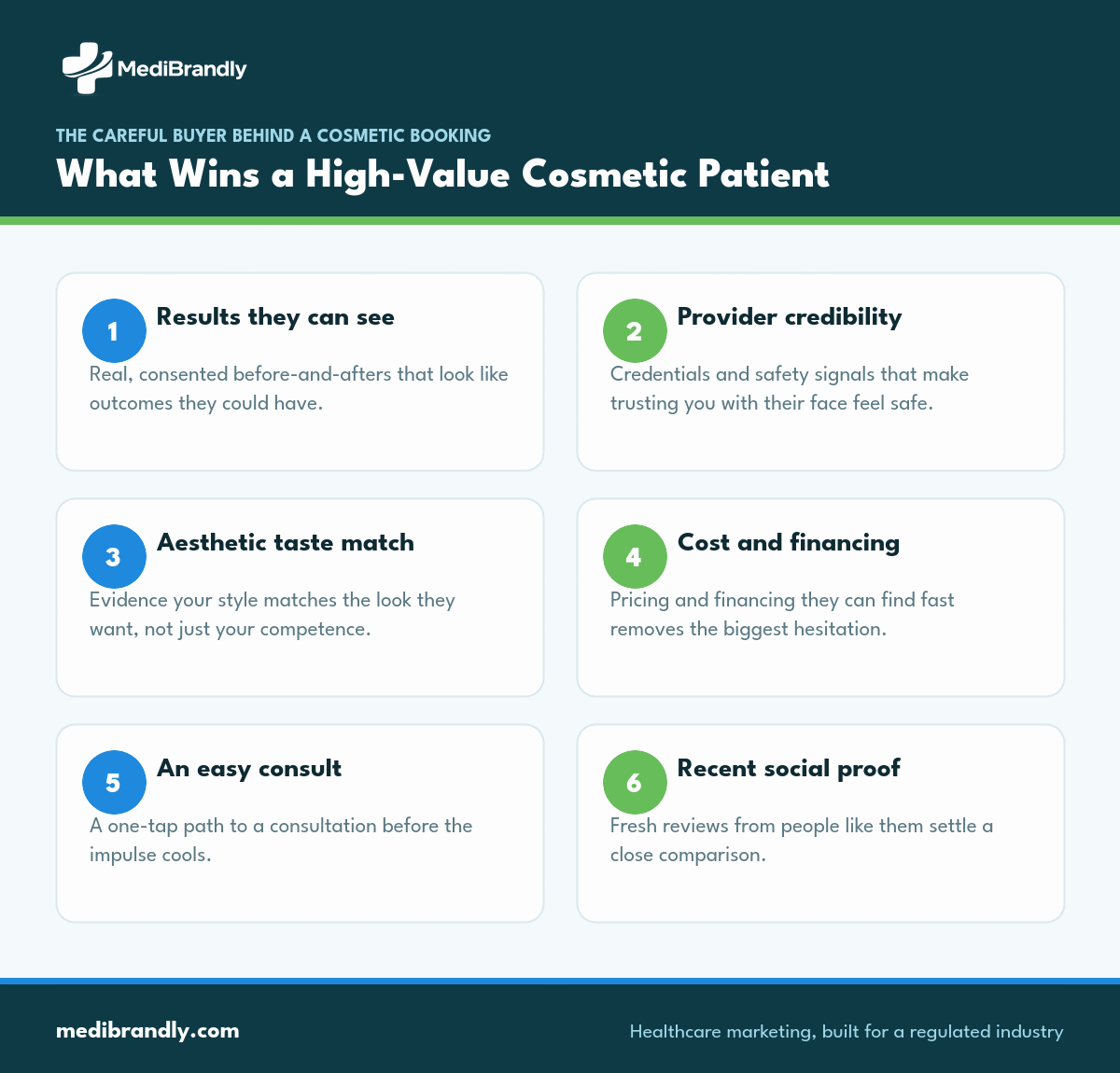
High-value elective patients are worth pursuing, but they’re careful buyers in a tightly-regulated category. Winning them takes visible proof, genuine trust, compliant creative, and a booking experience that removes every barrier.
We’ll separate your medical and aesthetic funnels, fix the leaks, and build the system that turns cosmetic interest into booked, high-value treatments.
Request your free dermatology marketing audit → or email info@medibrandly.com. You can also explore dermatology marketing or see results in our case studies.