
The three questions that separate a good healthcare agency from a risky one: who reviews your content for clinical accuracy, who owns your accounts and data, and whether reporting reaches booked appointments rather than stopping at traffic. If any answer is vague, keep looking.
Below are twelve questions worth asking in the first conversation, the contract terms that cause the most regret, and an honest framework for deciding between an agency, an in-house hire, and a hybrid.
What Makes a Healthcare Agency Different From a General One?
Three capabilities that a generalist genuinely does not carry, and that you are paying a premium for.
Clinical accuracy process. Health content is classified YMYL under Google’s quality guidelines and held to a higher standard. An agency without a review step is publishing medical claims written by someone guessing.
Compliance-aware measurement. Standard conversion tracking can send patient information to advertising platforms. Building attribution that doesn’t is materially harder than installing a tag, and it’s the failure we see most often in inherited accounts.
Platform policy fluency. Healthcare advertising carries category restrictions, and some specialties require certification before ads can run at all. An agency learning this on your account is learning it at your expense.
A general agency can absolutely do good work on your website and your brand. The risk concentrates in content and measurement.
Not sure whether your current agency is a fit? Book an agency-fit consultation — we’ll review what you’re being delivered against what you’re paying, and tell you honestly if the answer is “stay where you are.”
The 12 Questions to Ask Before You Sign
- How much of your work is healthcare, and in which specialties? “We have healthcare clients” is different from “healthcare is what we do.” Ask for the percentage and the specialties.
- Who reviews content for clinical accuracy, and what is the process? You want a named role and a defined step, not reassurance.
- Will you sign a BAA, and which of your tools touch patient data? Any vendor handling protected health information on your behalf needs an agreement in place.
- How do you track conversions without exposing patient information? Look for server-side event handling and identifier stripping. “We use Google Analytics” is not an answer to this question.
- Who owns the ad accounts, Google Business Profile, website and analytics? The answer must be the practice, on day one and on the day you leave.
- What exactly is delivered each month, in numbers? Pages, campaigns, posts, hours. “Ongoing optimization” is not a deliverable.
- What does reporting show, and does it reach booked appointments? Traffic and rankings are inputs. If nobody can tell you how many patients marketing produced, nobody is managing it.
- What is your approach to AI search? Patients increasingly start in AI answers. An agency with no view here is optimizing for a shrinking share of discovery.
- Who actually does the work, and who will I speak to? Find out whether the person in the pitch is the person on the account, and whether work is subcontracted.
- Can I speak to two current clients in a similar specialty? This matters more than tenure. A newer agency with verifiable, relevant work can outperform an older one coasting on templates — but you should be able to call someone. If references are refused, that is your answer.
- What are the contract terms, the notice period, and what do I keep? Long lock-ins are common; long lock-ins without performance reporting are not acceptable.
- **What would you tell me not to spend money on?** The most revealing question on this list. An agency that recommends everything is selling, not advising.
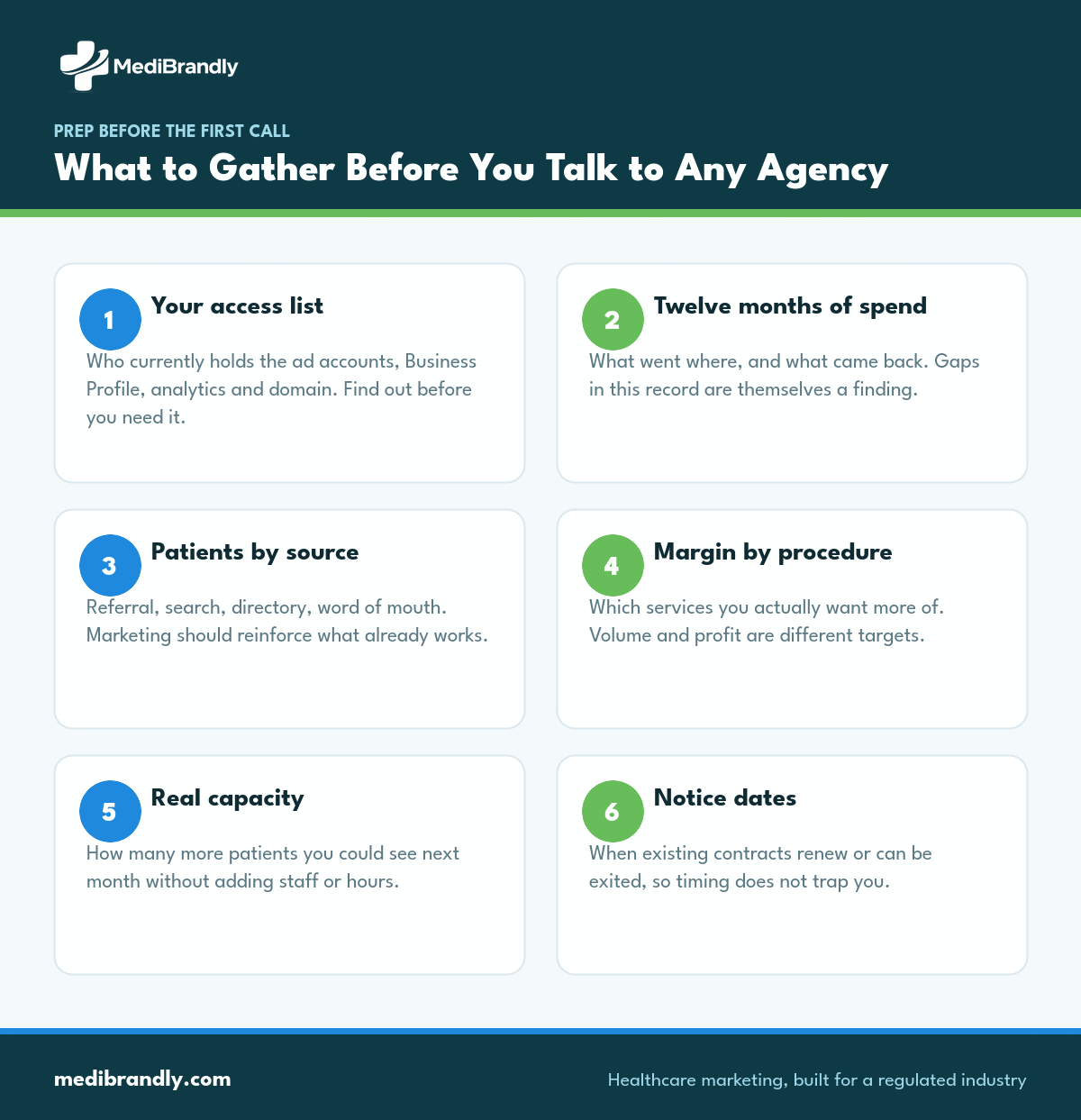
The Questions a Good Agency Should Ask You
Evaluation runs both ways, and the questions an agency asks in a first call reveal more than the answers they give. A team that starts pitching before diagnosing will sell you the same package they sell everyone.
Expect to be asked:
- Which patients are actually profitable for you? Volume and profit are different goals, and they need different campaigns. An agency that doesn’t ask will optimize for whichever is easier to report.
- What is your current capacity? If you cannot see more patients next month, generating more demand is waste. This should come up early.
- What happens when someone calls? Answer rates and follow-up speed cap the return on everything they’re about to build.
- Where do your patients come from today? Referrals, insurance directories, word of mouth. Marketing should reinforce what already works, not ignore it.
- What have you already tried, and what happened? Repeating a failed tactic with a new logo on the report is a common and expensive outcome.
- What would make this engagement a success in twelve months? If nobody agrees a number at the start, nobody can be held to one later.
If a first call is all portfolio and no diagnosis, you are being sold a product rather than a plan.
Contract Terms That Cause the Most Regret
Price is negotiated carefully and terms are skimmed, which is backwards — terms are what you live with.
| Term | What to Watch For | What Good Looks Like |
|---|---|---|
| Lock-in period | 12–24 months with no performance clause | 3–6 months initial, then rolling |
| Notice period | 90 days, or auto-renewal with a short cancellation window | 30 days, clearly stated |
| Account ownership | Agency-owned ad accounts or Business Profile | Everything in the practice’s name |
| Website ownership | Proprietary platform you cannot export | You own the site, hosting and content |
| Content rights | Agency retains rights to work you paid for | Work product transfers to you |
| Reporting | Vague “monthly reporting” | Named metrics, agreed cadence, appointment-level attribution |
| Scope changes | Silent reallocation of hours | Written change process |
| Exit handover | Unspecified | Defined transfer of accounts, data and assets |
The single most expensive clause is agency-owned accounts. Practices that leave those agreements often restart advertising history from zero — losing years of conversion data and paying more per click as a result.
Want a second opinion on a proposal before you sign? Send it over. We’ll tell you what’s missing and what’s fair, whether or not you work with us. Book a free consultation →
Agency, In-House, or Hybrid?
There is no universally right answer — it depends on scale and on which capabilities you need simultaneously.
In-house works when you need daily availability, deep institutional knowledge, and one or two channels rather than many. A capable healthcare marketer costs $60,000–$100,000+ annually plus tools. The limitation is coverage: one person rarely spans SEO, paid search, design, automation and compliance well.
An agency works when you need several specialisms at once without hiring several people, and when compliance and measurement expertise matter more than daily presence. The limitation is proximity — an external team knows your practice less intimately.
Hybrid works for most practices past a certain size: an in-house coordinator who owns brand, content input and internal alignment, with an agency supplying technical execution and specialist channels. It’s usually the best value above roughly $10,000 monthly spend.
For the cost comparison in detail, see our healthcare marketing cost breakdown and the budget benchmarks by specialty.
How to Run the Evaluation
A structured process takes about three weeks and prevents most bad decisions.
- Shortlist three. More than that and comparison becomes noise.
- Give each the same brief. Same goals, same budget range, same timeline. Proposals become genuinely comparable.
- Ask the twelve questions above on a call, not by email. You are assessing how they think, not how they write.
- Call the references — and ask what the agency is worst at.
- Compare scope, not price. The cheaper proposal usually contains less; the question is whether what’s missing matters.
- Start small where possible. A defined first project reveals more about working style than any pitch.
If you want to see how we approach this work before talking to anyone, our services overview and case studies are the fastest way in, and about us explains who you’d actually be working with.
Frequently Asked Questions
How much does a healthcare marketing agency cost?
Most practices pay $2,500–$8,000 per month with a healthcare specialist, and multi-location groups $10,000–$50,000+. Pricing depends on market competitiveness, number of locations and how much foundation work is required.
Should I hire a healthcare-specific agency or a general one?
For content and measurement, healthcare-specific is materially safer — clinical review and compliant tracking are the two things generalists routinely skip. For brand and web design alone, a strong general agency can work well.
How long should I commit to an agency?
Prefer three to six months initially, then rolling with a 30-day notice period. SEO needs four to six months to show meaningful results, so extremely short trials are unfair, but long lock-ins without performance reporting are not acceptable.
What if my agency won’t sign a BAA?
Find out precisely which tools touch patient information. If any do and they still refuse an agreement, that is a genuine compliance problem rather than a paperwork disagreement, and it should end the conversation.
Does agency tenure matter more than healthcare experience?
Relevant experience and verifiable results matter more than years in business. A newer team with deep healthcare focus often outperforms a long-established generalist — provided they can give you references in your specialty that you can actually call.
How do I know if my current agency is underperforming?
Ask for cost per booked patient. If they cannot produce it, or reporting stops at traffic and rankings, you cannot evaluate performance at all — and that is itself the finding.
Get an Honest Read on Your Options
The worst outcome isn’t choosing the wrong agency — it’s signing a contract you can’t exit while nobody can tell you what the marketing produced.
We’ll review your current setup, your proposals, and what your market realistically requires, then give you a straight recommendation. Sometimes that recommendation is to stay where you are, or to hire in-house instead.
Book your agency-fit consultation → or email info@medibrandly.com. You can also read more about our team or browse case studies.