To get cited in Google AI Overviews, a medical practice needs three things: answer-first content that directly resolves patient questions, strong E-E-A-T signals (named clinicians, credentials, and sourced claims), and structured data such as FAQPage and MedicalOrganization schema that AI systems can reliably extract.
That’s the short answer. The rest of this guide shows you exactly how to build each of those three pillars — because in 2026, being quoted inside an AI answer has quietly become more valuable than ranking #1 in the traditional blue links.
Why AI Overviews Now Decide Which Practice Gets the Patient
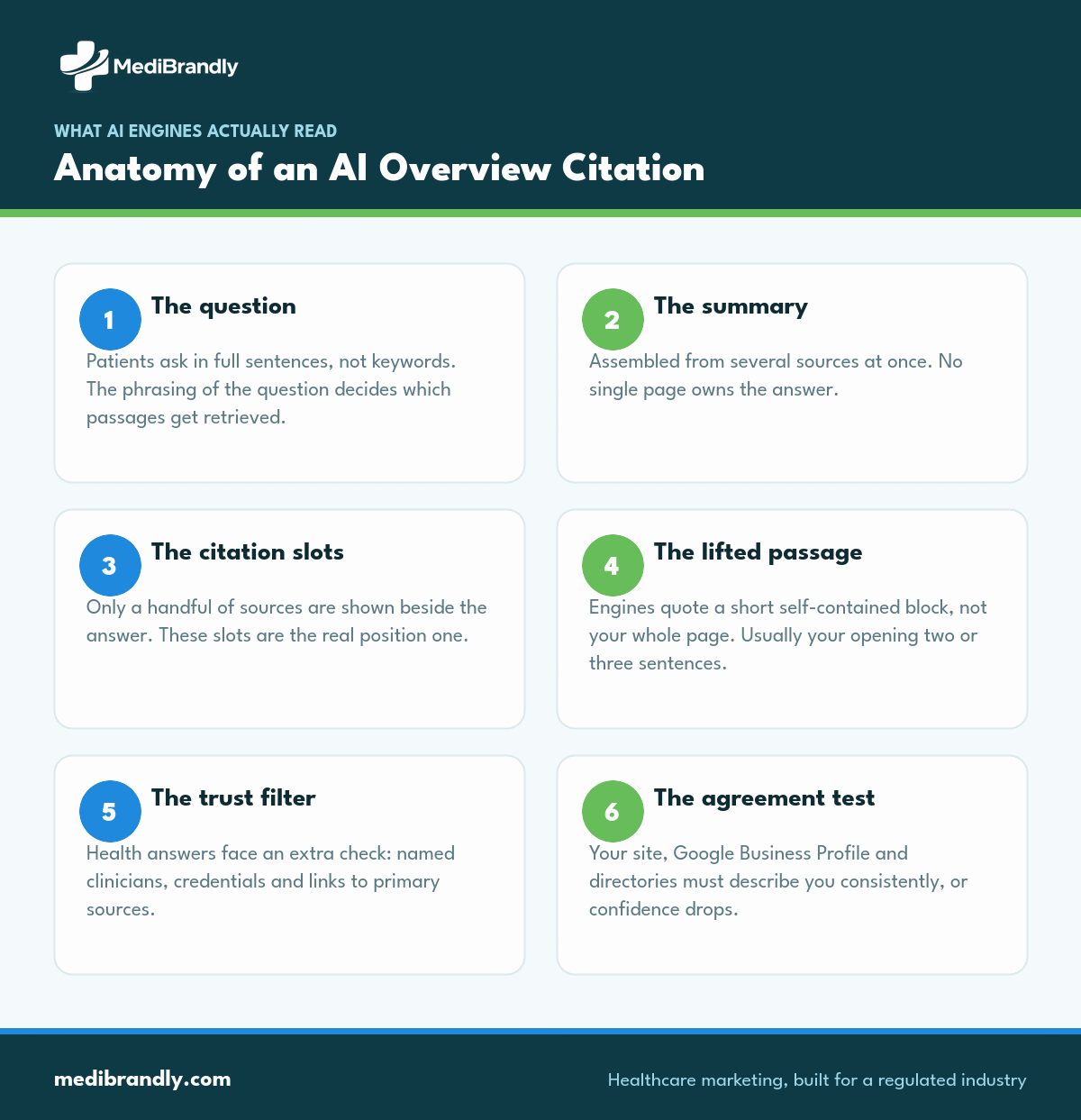
When a patient searches “how to find a cardiologist near me,” “what does a dermatology consultation cost,” or “is online therapy effective,” Google increasingly responds with an AI-generated summary at the very top of the page — before any organic result. That summary cites a handful of sources. If your practice is one of them, you shape the patient’s decision before your competitors are even seen. If you’re not, you’re invisible at the exact moment care is being chosen.
The behavioral data behind this shift is hard to ignore. A majority of U.S. adults now encounter AI-generated summaries in their search results, according to Pew Research Center, and roughly a third of consumers already use generative AI tools for health-related research. Traffic from AI answers is smaller in volume than classic organic traffic — but it converts at several times the rate, because the AI has already done the filtering. The patient arriving from an AI citation isn’t browsing; they’re choosing.
This is why Answer Engine Optimization (AEO) — sometimes called Generative Engine Optimization (GEO) — now sits alongside traditional healthcare SEO as a core discipline rather than a novelty.
Not sure whether AI engines can even see your practice today? Request a free AI-visibility audit — we’ll show you which patient queries trigger AI Overviews in your market and who’s being cited instead of you.
What Is Answer Engine Optimization (AEO) for Healthcare?
Answer Engine Optimization is the practice of structuring your website’s content, credentials, and technical markup so that AI-powered search systems — Google AI Overviews, Google AI Mode, ChatGPT Search, Perplexity, and Gemini — can extract, trust, and cite your pages when answering patient questions.
It differs from traditional SEO in one crucial way:
| Traditional SEO | AEO / GEO | |
|---|---|---|
| Goal | Rank a page in a list of results | Be quoted inside a generated answer |
| Unit of optimization | The page | The passage (2–4 sentence answer block) |
| Key signals | Links, keywords, technical health | Extractability, authorship, corroboration, sources |
| Success metric | Position and clicks | Citations, branded mentions, high-intent visits |
| Healthcare stakes | High (YMYL) | Higher — AI engines apply extra trust filters to medical content |
The two are complementary. AI systems still lean heavily on pages that already rank well and hold featured snippets, so AEO sits on top of a healthy SEO foundation — it doesn’t replace it.
How Do AI Engines Decide Which Medical Sources to Cite?
AI engines cite healthcare sources that demonstrate three qualities: extractability (clear, self-contained answers), credibility (named authors, credentials, and citations to primary sources), and corroboration (consistent information about your practice across your site, Google Business Profile, directories, and reviews).
Because health content is “Your Money or Your Life” (YMYL) territory, the bar is higher than in any other industry. An anonymous blog post with no byline will almost never be cited for a medical query, no matter how well-written. A page authored by a named, board-certified physician, with a reviewed date and links to primary sources, has a structurally different trust profile.
The 9-Step AEO Checklist for Medical Practices
1. Rewrite key pages answer-first
Open every service page, condition page, and blog post with a direct 2–3 sentence answer to the question the page targets — before any preamble about your practice. This opening block is precisely what AI systems lift. Then expand: what the treatment is, who it’s for, what it costs, what to expect, how to book.
2. Turn H2s into real patient questions
“How much does a dermal filler treatment cost?” beats “Our Pricing.” AI engines match generated questions to question-formatted headings. Answer each H2 in the first 40 words beneath it.
3. Add the schema stack
Implement Schema.org structured data across the site: MedicalOrganization or Physician for the practice, FAQPage on every page with Q&As, Article with author markup on blog content, and MedicalCondition/MedicalProcedure where relevant. Schema doesn’t guarantee citation, but its absence removes a trust signal AI parsers actively use. If your site needs technical work to support this, that’s a web design and development project, not a plugin toggle.
4. Put real clinicians on every page
Byline articles with the treating provider’s name and credentials. Build complete bio pages (education, board certifications, specialties, headshot) and link them from every piece of content they author or review. Add “Medically reviewed by Dr. X, [date]” blocks to clinical content.
5. Cite primary sources — never thin aggregators
Link claims to the CDC, NIH, specialty medical associations, and government sources. AI systems evaluate your outbound citations as part of your trust profile.
6. Answer the questions patients actually research before choosing
Cost, insurance coverage, safety, recovery time, and what happens at the first visit. Astonishingly few practice websites answer these plainly — the ones that do earn both the ranking and the citation.
7. Strengthen off-site corroboration
Your practice must be described consistently everywhere: Google Business Profile, Healthgrades, specialty directories, and review platforms. Conflicting hours, addresses, or provider lists make AI systems less confident recommending you. Review recency matters too — AI engines weight fresh, detailed reviews as evidence you’re active and trusted.
8. Win featured snippets first
Pages that already hold featured snippets are statistically more likely to be pulled into AI Overviews. Definition blocks, numbered steps, and comparison tables are your snippet vehicles.
9. Keep everything current
AI engines heavily favor recency for healthcare. Update accepting-new-patients status, telehealth availability, hours, and pricing promptly — and display “Reviewed” dates on content.
Want this executed for you? MediBrandly builds AEO-ready content systems for practices in every specialty — from dental to mental health to multi-location groups. Book a free strategy consultation →
How Long Does It Take to Appear in AI Overviews?
Most practices with a solid domain start earning AI citations within 3–6 months of restructuring content, adding schema, and strengthening E-E-A-T signals. New or weak domains take longer because AI engines require the same underlying authority that traditional rankings do.
Track progress by: (1) manually testing your priority patient queries in AI Overviews, ChatGPT Search, and Perplexity monthly; (2) watching Google Search Console for rising impressions on question-format queries; and (3) monitoring referral traffic from AI platforms in your analytics setup.
Frequently Asked Questions
What is AEO in healthcare marketing?
AEO (Answer Engine Optimization) is structuring medical website content so AI search systems — Google AI Overviews, ChatGPT, Perplexity — can extract and cite it when answering patient questions. It focuses on answer-first passages, E-E-A-T signals, and schema markup.
Do AI Overviews reduce website traffic for medical practices?
They reduce clicks on informational queries, but the visits that do come through convert at far higher rates because patients arrive pre-qualified. The net effect for practices with strong AEO is more booked appointments from fewer visits.
Is AEO different from SEO?
Yes, but they’re complementary. SEO earns rankings in result lists; AEO earns citations inside AI-generated answers. AI engines draw heavily from pages that already rank, so a strong SEO foundation remains essential.
Does schema markup guarantee my practice appears in AI answers?
No. Schema is a credibility and extraction signal, not a ranking guarantee. It works in combination with answer-first content, named clinical authorship, and consistent off-site information.
Which AI platforms matter most for patient acquisition in 2026?
Google AI Overviews and AI Mode reach the largest patient audience by far, followed by ChatGPT Search and Perplexity. Optimizing for Google’s AI features generally improves visibility across all of them, since the trust signals overlap.
Can a small single-location practice compete in AI search?
Yes — often more easily than in traditional SEO. AI engines reward genuine expertise signals (named board-certified providers, complete profiles, strong reviews) over sheer content volume, which levels the field against bigger publishers.
Get Found Where Patients Are Actually Searching
The practices winning 2026 aren’t producing more content — they’re producing content AI engines can trust and quote. MediBrandly builds that system end to end: SEO and AEO strategy, schema-ready web development, and measurement that ties citations to booked patients.
Request your free AI-visibility audit → or email info@medibrandly.com — we’ll show you exactly which AI answers your competitors currently own, and how to take them.