
The fastest ways to get more patients in 2026 are: dominating local search (Google Business Profile + local SEO), building steady review velocity, running high-intent Google Ads priced against booked appointments, becoming citable in AI search results, and fixing the follow-up leaks that lose the leads you already generate.
Below are all 15 strategies, ranked roughly by return on effort for a typical practice — with the honest caveats most listicles leave out.
First: Where Patients Actually Come From in 2026
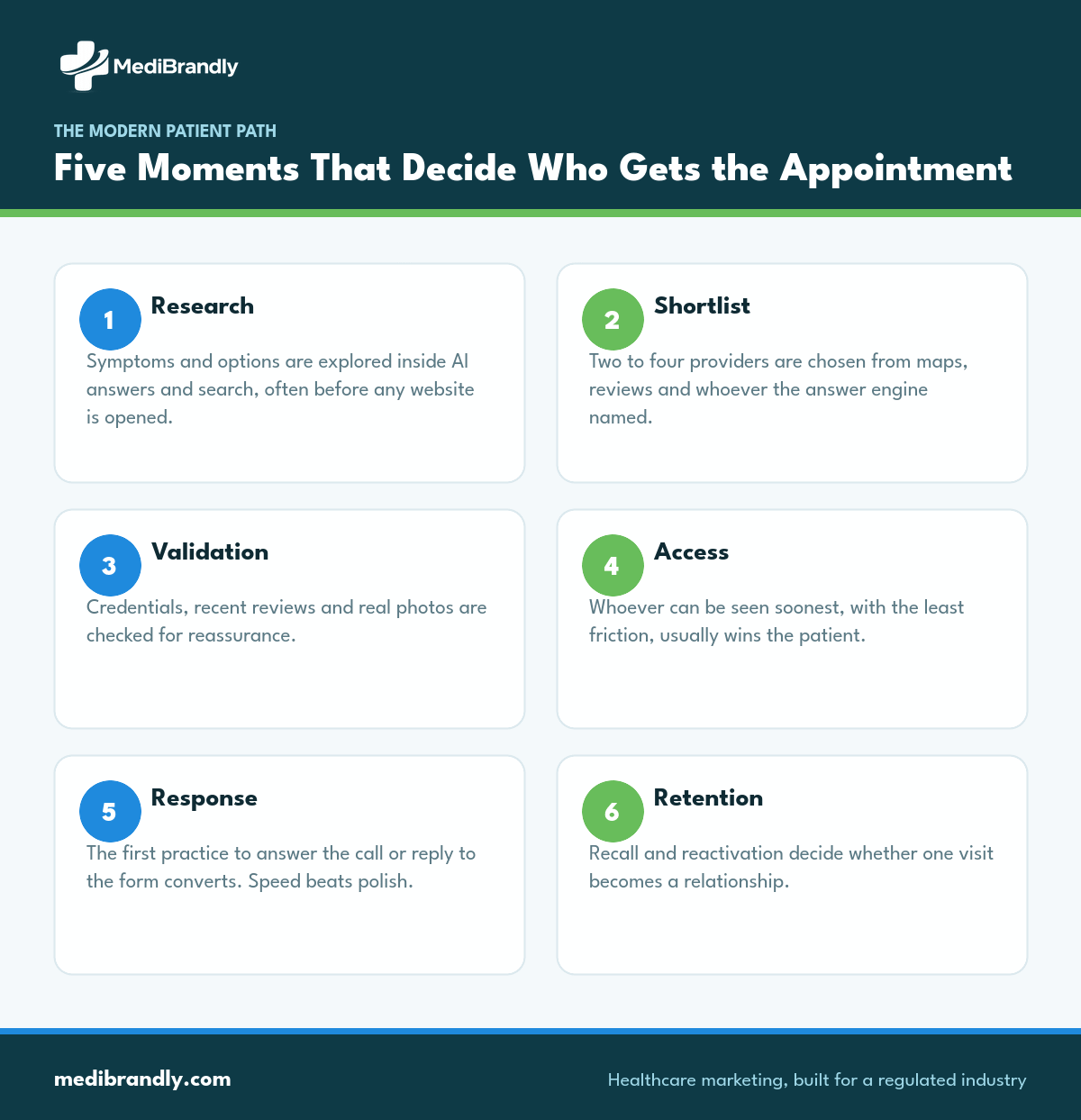
Patient behavior has shifted in two directions at once. Discovery has moved upstream into AI — patients ask Google AI Overviews or ChatGPT to explain symptoms, compare treatment options, and shortlist providers before ever visiting a website. And decision-making has become access-driven: patients don’t just ask who is good, they ask who can see me soonest, with the least friction. Your marketing has to win both moments. Most of the strategies below serve one or the other.
Shortcut: If you’d rather have this diagnosed for your specific practice, book a free patient-growth consultation — we’ll identify your three biggest acquisition gaps in one call.
The 15 Strategies
1. Optimize your Google Business Profile like it’s your homepage
For local care, your GBP often gets more patient eyeballs than your website. Complete every field, choose precise primary and secondary categories, list services individually, add photos monthly, answer Q&As, and connect booking links. Google’s own guidance confirms completeness and activity influence local visibility.
2. Build review velocity — not just review count
In 2026, recent reviews are weighted heavily in local rankings, and AI platforms scan review language to understand what your practice is known for. Build a compliant, automated ask into your visit workflow (SMS or email within hours of the appointment) so fresh reviews arrive every week — a system a good CRM setup runs on autopilot. Never gate reviews or confirm a patient relationship when replying publicly.
3. Win the local map pack with local SEO
Three positions in the map pack capture the majority of local clicks. Location pages for every service + area, consistent name/address/phone across directories, and local schema markup form the foundation. This is the highest-compounding investment in healthcare SEO.
4. Become citable in AI Overviews (AEO)
Structure your service and condition pages answer-first, add FAQ schema, and put named clinicians behind your content so AI engines can quote you. Patients arriving from AI citations convert at multiples of ordinary organic visitors. Full playbook: our AI Overviews guide for medical practices.
5. Run Google Ads against booked appointments, not clicks
High-intent searches (“same day dentist near me,” “adhd psychiatrist accepting new patients”) are the closest thing to patients raising their hands. The difference between profitable and wasteful healthcare PPC is conversion-based bidding fed by call tracking and booking data — not impressions.
6. Turn your website into a booking machine
Speed, mobile experience, visible phone number, online scheduling above the fold, and insurance information answered plainly. Every extra step between “I want an appointment” and confirmation loses patients — an access problem, not a traffic problem, and the core of good healthcare web design.
7. Answer cost and insurance questions publicly
“How much does X cost” and “does insurance cover X” are among the highest-volume queries in every specialty — and the least answered. Publishing honest ranges earns rankings, AI citations, and patient trust simultaneously.
8. Fix your follow-up leaks (the cheapest patients you’ll ever get)
Practices routinely lose 20–40% of inquiries to slow or absent follow-up. Instant response to form fills, same-day callbacks, and automated nurture for not-yet-ready leads recover patients you already paid to attract. This is CRM and automation territory and usually the fastest ROI on this list.
9. Reactivate dormant patients
Your past-patient list is a warm audience competitors can’t touch. Recall campaigns by email and SMS — checkup reminders, benefit-expiry notices (dental), seasonal campaigns — reliably refill schedules at near-zero acquisition cost.
10. Publish physician-led short video
Clinician-fronted short-form video consistently outperforms polished brand content because patients respond to authenticity. One provider, one common question, 60 seconds — repurposed across social channels, GBP, and service pages.
11. Build a referral engine — professional and patient
Systematize what most practices leave to chance: regular updates to referring providers, easy referral pathways, thank-you loops, and a simple patient referral ask at moments of expressed satisfaction.
12. Use Local Services Ads where available
Google’s LSAs put verified providers at the very top of results on a pay-per-lead basis, with screening requirements that thin out competition. Especially effective for dental and urgent-access specialties.
13. Publish genuinely useful condition content
Top-of-funnel content (“what to expect at your first physical therapy session”) builds the topical authority that lifts your entire site’s rankings — and gives AI engines reasons to trust you. Quality over volume; every piece medically reviewed.
14. Market access, not just expertise
“Same-week appointments.” “Evening hours.” “New patients welcome.” Lead with availability in ads, GBP posts, and page headlines. In 2026, access messaging outperforms credential messaging for first-visit conversion.
15. Measure with HIPAA-safe attribution — then double down
None of the above compounds if you can’t see what’s working. Server-side, consent-based tracking and call attribution tied to booked appointments — built compliantly per HHS guidance on tracking technologies — is what lets you cut losers and scale winners. That’s the entire purpose of our analytics and reporting service.
Which Strategies Should You Start With?
| Your Situation | Start With | Then Add |
|---|---|---|
| New practice, no online presence | 6, 1, 3 (website, GBP, local SEO) | 5, 2 (PPC, reviews) |
| Established but plateaued | 2, 8, 9 (reviews, follow-up, reactivation) | 4, 13 (AEO, content) |
| Spending on ads with weak results | 15, 5, 6 (attribution, PPC rebuild, site conversion) | 8 |
| Competitive elective specialty | 5, 10, 7 (PPC, video, cost content) | 4, 12 |
| Multi-location group | 3, 15, 1 at scale | 4, 8 — see multi-location marketing |
Frequently Asked Questions
What is the fastest way to get more patients?
Google Ads on high-intent local searches, combined with instant lead follow-up, produces new patients within days. Local SEO and reviews take months but compound into your cheapest long-term source.
How do medical practices attract patients without advertising?
Through local SEO, Google Business Profile optimization, review generation, referral systems, reactivation of past patients, and answer-first content that earns organic and AI-search visibility.
How much should I budget to acquire a new patient?
Well-run programs typically acquire patients at a blended $150–$400 each, varying by specialty. Compare that against patient lifetime value — details in our healthcare marketing cost guide.
Do online reviews really affect patient acquisition?
Yes — the overwhelming majority of patients read reviews before choosing a provider, and review recency now influences local rankings and how AI platforms describe your practice.
What marketing works best for small practices?
Local SEO, GBP optimization, and review velocity deliver the most patients per dollar for single-location practices, because they capture existing local demand rather than creating new demand.
How is patient acquisition different in 2026 than before?
Discovery starts in AI answers, decisions hinge on access and reviews, and privacy rules restrict old tracking methods. Practices that structure content for AI citation, market availability, and measure compliantly are pulling ahead.
Ready to Fill Your Schedule?
Every strategy above works — the question is which three will move your numbers fastest. That depends on your specialty, market, and current funnel, and it’s exactly what we map in a free strategy consultation.
Book your consultation → or email info@medibrandly.com — and browse our case studies to see what these systems produce in practices like yours.