
Healthcare SEO typically costs $1,500–$7,500 per month for a single-location practice and $7,500–$25,000+ per month for multi-location groups. Project-based work runs $5,000–$30,000, and credible freelancers charge $75–$200 per hour.
That spread is wide because “SEO” describes anything from automated report emails to a full content, technical, and AI-search program. This guide breaks down what each price level actually buys, so you can tell which one you’re being quoted.
What Actually Drives Healthcare SEO Pricing?
Four variables explain most of the difference between a $1,500 quote and a $15,000 one.
Market competitiveness. Ranking a dermatology practice in a large metro means outranking dozens of well-funded competitors. The same work in a smaller market takes a fraction of the effort. Geography moves price more than any other single factor.
Number of locations. Each location needs its own location page, Google Business Profile management, review workflow, and local citations. Costs scale close to linearly with locations, which is why multi-location groups sit in a different pricing bracket entirely.
Content volume and medical review. Healthcare content is classified YMYL (“Your Money or Your Life”) under Google’s quality guidelines, which means it’s held to a higher accuracy standard. Content that goes through clinical review costs more to produce than content that doesn’t. That review is also the thing that makes the content rank.
Your starting point. A practice with a slow site, no schema, thin service pages, and an unclaimed Google Business Profile needs foundation work before ongoing SEO produces anything. Agencies either front-load that as a onboarding project or bake it into the first few months.
Want a number instead of a range? Request an SEO pricing proposal and we’ll scope your market, competitors, and current site into a line-item monthly figure — with the expected timeline attached.
Healthcare SEO Cost by Provider Type
| Provider | Typical Cost | What You Realistically Get | Best Fit |
|---|---|---|---|
| DIY / in-house staff | $0–$500/mo (tools) | GBP management, basic on-page fixes, review requests | Very small practices in low-competition markets |
| Freelancer | $75–$200/hr, or $750–$2,500/mo | One specialty done well (usually content or technical), limited coverage | Filling a specific gap alongside existing effort |
| General marketing agency | $1,000–$4,000/mo | Competent standard SEO, but rarely medical review or HIPAA-safe measurement | Practices with simple, low-risk marketing needs |
| Healthcare-specialist agency | $2,500–$7,500/mo (single location) | Technical + local + content + AEO, clinical review, compliant tracking | Practices competing for high-value patients |
| Specialist agency, multi-location | $7,500–$25,000+/mo | Everything above at scale, per-location reporting, centralized governance | Groups, DSOs, MSOs, PE-backed platforms |
Ranges reflect typical U.S. market rates in 2026. Quotes vary by specialty and market.
One-Time Projects vs Monthly Retainers
Not all healthcare SEO is a retainer, and knowing which model you need prevents overbuying.
One-time projects ($5,000–$30,000) make sense when the problem is structural: a site migration, a technical overhaul, a schema and site-architecture rebuild, or a batch of service pages written and optimized once. You pay for a defined deliverable and own it afterward. This is the right model if your fundamentals are broken but you have someone internally who can maintain things.
Monthly retainers ($1,500–$25,000+) make sense when you need continuous output: new content, ongoing local SEO, review velocity, competitor response, and reporting. SEO rankings decay when competitors keep publishing and you stop, so most practices competing for high-value patients end up here.
The common sequence is a foundation project followed by a lighter retainer. Practices that skip the foundation and start with a retainer often spend the first four months paying retainer rates for what was really one-time cleanup work — which is a slow, expensive way to buy a technical audit.
Ask any prospective agency which portion of month one is foundation versus ongoing. A clear answer is a good signal.
What Should Be Included at Each Price Level?
Price alone tells you very little. What matters is which of these are actually in scope:
- Technical SEO — site speed, crawlability, indexation, mobile experience, schema markup. Foundation work; usually heaviest in months one to three.
- Local SEO — Google Business Profile optimization, location pages, citation consistency, review velocity. For most practices this drives the largest share of new patients.
- Content production — service pages, condition pages, and blog content answering what patients actually search. Ask how many pieces per month and who reviews them.
- AEO / AI search optimization — structuring content so AI engines can extract and cite it. In 2026 this is no longer optional; see our guide to earning AI Overview citations.
- Digital PR and link earning — the slowest and most expensive component, and the one most often quietly dropped from cheaper retainers.
- Measurement — HIPAA-safe analytics and call tracking that ties rankings to booked appointments rather than to traffic.
A $2,000 retainer might cover items 1–3 competently. A retainer claiming all six for $800 is not doing all six.
Why Does Healthcare SEO Cost More Than General SEO?
Because three things are required that generic SEO simply skips.
Medical accuracy review adds a clinical reviewer to the content workflow. Compliance-safe measurement means tracking that doesn’t leak patient data to ad platforms, which is meaningfully harder to build than pasting in a standard analytics tag — see our HIPAA marketing rules guide for what that constrains. And YMYL content standards mean Google applies stricter quality expectations to health content than to almost any other category, so thin content doesn’t just underperform, it can drag down the whole domain.
An agency that treats a cardiology practice like an e-commerce store will be cheaper. It will also expose you to risks you didn’t price in.
Not sure whether your current SEO spend is working? We’ll audit your rankings, technical health, and AI-search visibility against your local competitors, then show you what a right-sized program looks like. Book a free strategy consultation →
Warning Signs of Cheap Healthcare SEO
- $299–$500/month packages. These fund automated reporting and templated content. On a YMYL site, thin content can actively harm you.
- Guaranteed rankings. Nobody can guarantee positions. Google states this explicitly — treat a guarantee as a disqualifier.
- No mention of AI search. An agency ignoring AEO in 2026 is optimizing for a shrinking share of patient discovery.
- No clinical review process. Ask directly who checks medical claims. If the answer is vague, your content is being written by someone guessing.
- They own your accounts. Your Google Business Profile, Analytics, and website must belong to the practice, not the agency.
- Reporting that stops at traffic. Sessions and impressions are inputs. If nobody can tell you how many appointments SEO produced, nobody is managing it.
Is Healthcare SEO Worth the Cost?
The honest answer depends on patient lifetime value, and the math is usually favorable.
A family practice patient may be worth $1,500–$3,000 over the relationship. A dental implant case can run $3,000–$30,000. If a $3,000/month program produces eight new patients a month, blended acquisition cost is $375 each — comfortably profitable in nearly every specialty.
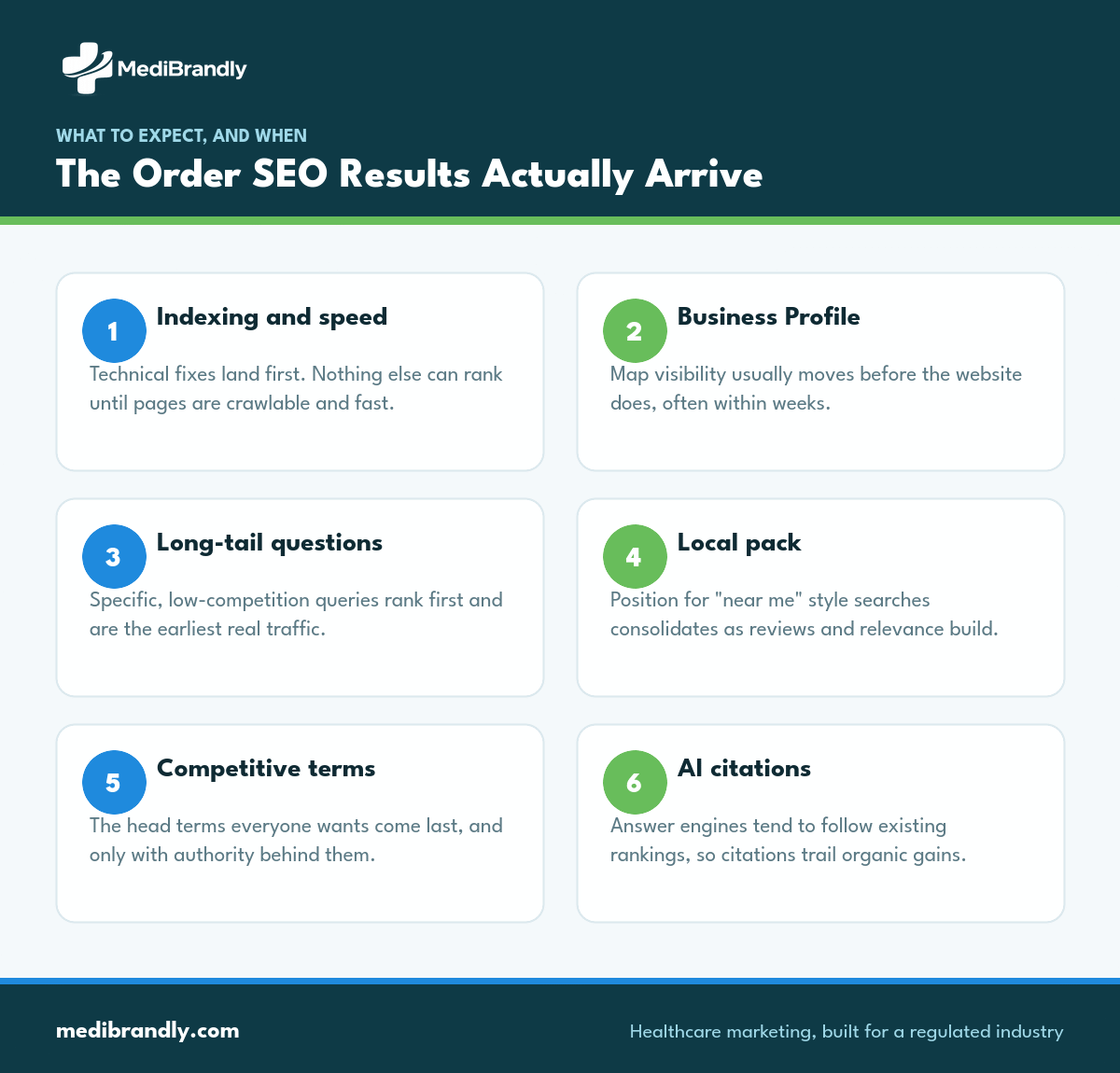
Two caveats worth being direct about. SEO is slow: expect meaningful movement around months four to six, compounding after. And it only compounds if you can measure it, which is why analytics and reporting belongs in the budget rather than being treated as a nice-to-have. For how SEO fits alongside PPC, web, and CRM spend, see our full healthcare marketing cost breakdown.
If you’re weighing scope and sequencing rather than raw price, that’s a strategy conversation before it’s a budget one.
Frequently Asked Questions
How much does healthcare SEO cost per month?
Most single-location practices pay $1,500–$7,500 per month with a healthcare-specialist agency. Multi-location groups typically range from $7,500 to $25,000+ per month, depending on location count and market competitiveness.
Is healthcare SEO worth it for a small practice?
Usually yes, because local SEO captures existing demand rather than creating it. A single-location practice in a moderate market can compete effectively on Google Business Profile optimization, reviews, and well-structured service pages.
How long does healthcare SEO take to work?
Expect early technical and local gains within 60–90 days, meaningful ranking movement around months four to six, and compounding growth after that. Any agency promising first-page rankings in 30 days is describing something that doesn’t exist.
Should I hire a freelancer or an agency for medical SEO?
A freelancer works well for one defined gap, like technical fixes or content writing. Practices needing technical, local, content, AEO, and compliant measurement together generally get broader coverage from a specialist agency than from stacking freelancers.
What’s the difference between healthcare SEO and regular SEO?
Healthcare SEO adds clinical accuracy review, YMYL-grade content standards, and HIPAA-conscious measurement. The ranking fundamentals are the same; the accuracy and compliance requirements around them are substantially higher.
Does healthcare SEO include AI search optimization?
It should in 2026. Patients increasingly start in AI Overviews and chat assistants, so answer-first content, schema markup, and E-E-A-T signals need to be part of the scope rather than a separate upsell.
Get a Real SEO Number for Your Practice
Ranges are a starting point, not a proposal. What your practice should spend depends on your specialty, how competitive your market actually is, and how much foundation work your current site needs.
We’ll analyze your market, benchmark you against the practices outranking you, and return a line-item scope with the number attached — including what we’d deprioritize to keep the budget honest.
Request your SEO pricing proposal → or email info@medibrandly.com. You can also see what these programs produce in our case studies, or review what’s included in healthcare SEO services.