
Most single-location dental practices pay $1,500–$6,000 per month for SEO, with competitive metro markets running $5,000–$10,000+. Multi-location groups and DSOs typically budget $7,500–$30,000+ per month, scaling with location count.
Dental sits at the expensive end of local SEO for one reason: nearly every practice in your zip code is bidding for the same few hundred searches a month. Here’s what each price tier actually buys.
Why Is Dental SEO Priced Higher Than Other Local SEO?
Dentistry is one of the most saturated local search categories in the country. A suburban zip code can hold twenty general dentists, all targeting “dentist near me” and “emergency dentist.” Unlike a cardiology practice drawing from a wide referral region, you’re competing inside a three-mile radius.
Two other forces push dental pricing up.
High-value procedures attract high-value competition. Implants, orthodontics, and cosmetic cases are worth thousands each, so practices invest heavily to win them. Terms like “dental implants” and “Invisalign near me” carry some of the steepest costs in local healthcare marketing, and the SEO effort tracks that.
Dental is a YMYL category. Google applies its “Your Money or Your Life” quality standards to health content, which means treatment pages need genuine clinical accuracy and named provider credentials — not the templated copy a general local-SEO package produces.
Want to know what your market actually costs? Request a free dental SEO market analysis — we’ll show you who’s ranking in your radius, what they’re doing, and the realistic investment to outrank them.
Dental SEO Pricing by Practice Type
| Practice Situation | Typical Monthly Cost | What It Realistically Covers |
|---|---|---|
| Single practice, low-competition market | $1,500–$2,500 | GBP optimization, reviews, core service pages, basic technical |
| Single practice, suburban/moderate market | $2,500–$5,000 | Above + ongoing content, local link building, AEO structuring |
| Single practice, competitive metro | $5,000–$10,000+ | Aggressive content, digital PR, procedure-level pages, conversion work |
| Practice pushing high-value procedures (implants, ortho, cosmetic) | $4,000–$10,000 | Procedure-specific funnels, financing pages, before/after compliance |
| Multi-location group or DSO | $7,500–$30,000+ | Per-location local SEO, centralized governance, rollup reporting |
Ranges reflect typical U.S. market rates in 2026. Your quote depends on radius competition more than practice size.
What Should a Dental SEO Retainer Include Each Month?
Ask any prospective agency to confirm which of these are in scope. A credible dental retainer covers:
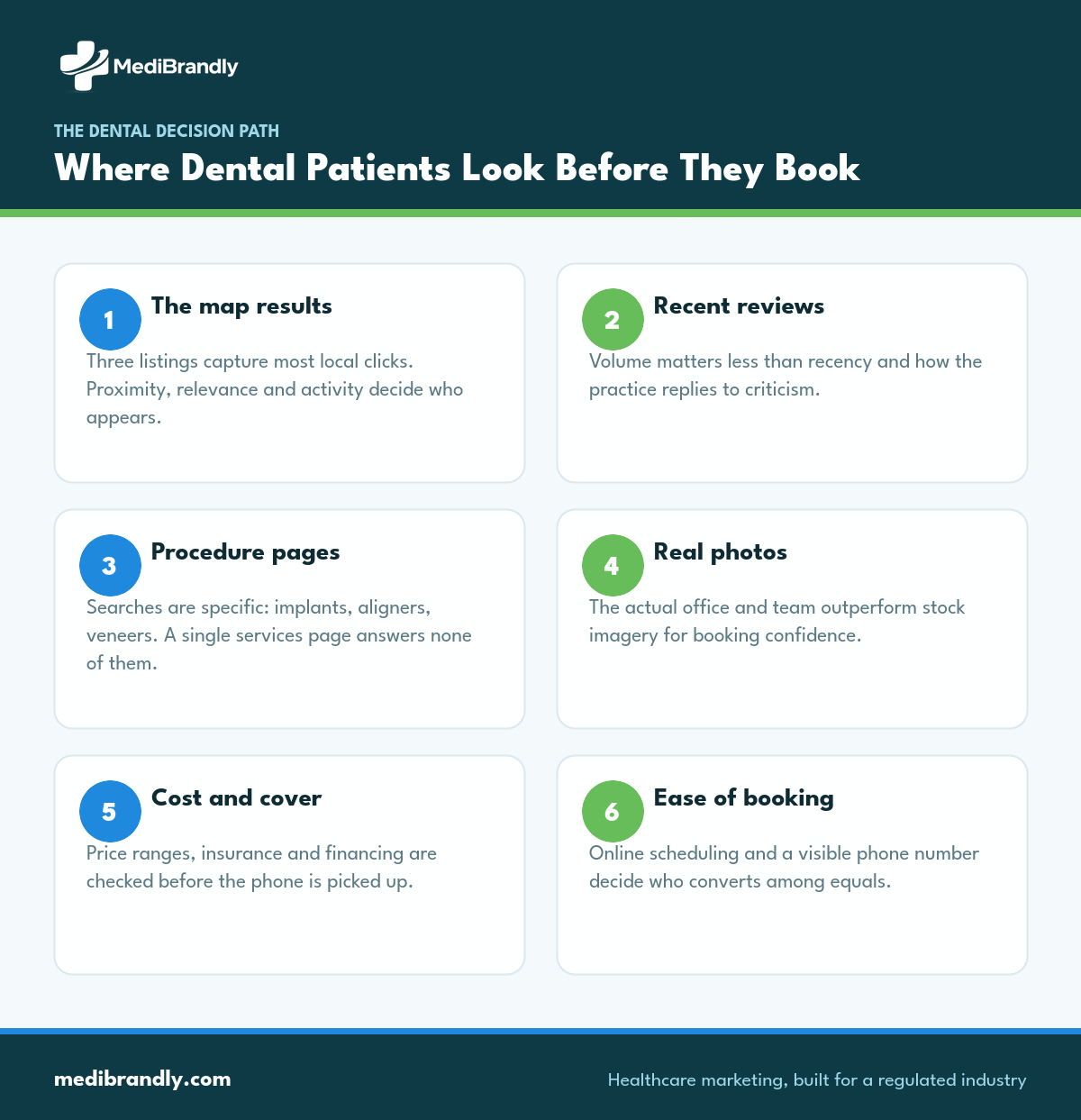
- Google Business Profile management — posts, photos, Q&A seeding, category accuracy, service listings. For dental, GBP frequently outproduces the website for new-patient calls.
- Review generation and response — a compliant, automated request in the post-visit workflow. Review recency is one of the strongest local ranking inputs, and dental patients read heavily before booking.
- Procedure pages, not just service pages — separate, genuinely useful pages for implants, Invisalign, veneers, emergency care, and sedation. One “Services” page will not rank for any of them.
- Location and neighborhood targeting — for practices drawing from multiple suburbs, pages that speak to each area without duplicating content.
- Technical health — speed, mobile experience, schema markup, and working online booking. Dental searches skew heavily mobile and heavily urgent.
- AEO / AI search structuring — answer-first content and FAQ schema so AI engines can cite you when patients ask about cost, pain, or recovery. Our AI Overviews guide covers the mechanics.
- Reporting tied to booked appointments — call tracking and form attribution, not a rankings PDF.
If a $900/month quote claims all seven, it is not delivering all seven.
Single Practice vs DSO: Where the Money Goes Differently
For a single practice, spend concentrates on winning one radius: GBP, reviews, a tight set of procedure pages, and local links. The work is deep rather than broad, and results are usually visible in local pack movement within a few months.
For a DSO or multi-location group, the challenge inverts. You need consistent architecture across every location, individual GBP listings managed at scale, per-location reporting so regional managers can act, and brand governance that stops each office publishing its own conflicting information. Cost scales with locations, but so does efficiency — content and technical work built once deploys everywhere. That operating model is closer to multi-location healthcare marketing than to classic single-practice SEO.
What Makes Dental SEO Different From General SEO
Three requirements that generic agencies routinely skip, and that you are paying for with a specialist:
Provider credentials on treatment content. Pages describing procedures should carry the treating dentist’s name and credentials. This is a direct E-E-A-T signal and increasingly a factor in whether AI engines will cite you at all.
Before-and-after compliance. Case photos convert extremely well and carry real rules: patient authorization before publishing, and no implied guarantees of outcome. Publishing them casually creates exposure that a general agency will not warn you about.
Careful claim language. Treatment descriptions need to avoid guaranteeing results or making comparative superiority claims. “Painless,” “permanent,” and “best” are the words that cause problems.
Already spending on dental SEO and unsure it’s working? We’ll audit your rankings, GBP health, and AI-search visibility against the practices outranking you, then show you where the budget is actually going. Book a free strategy consultation →
What Should the First Six Months Look Like?
A credible engagement front-loads foundation work, then shifts to compounding output. Roughly:
Months 1–2 — foundation. Technical audit and fixes, Google Business Profile overhaul, schema markup, review workflow installed, tracking and call attribution configured. You should see GBP impressions move first; website rankings usually haven’t shifted yet.
Months 3–4 — content and local authority. Procedure pages written and published, location targeting built out, local citations cleaned up, first links earned. Local pack positions typically begin moving here.
Months 5–6 — compounding. Rankings consolidate, review volume builds, and attributable calls and bookings become visible in reporting. This is the earliest point at which ROI can be judged honestly.
If an agency cannot describe a sequence like this for your practice, they are selling a retainer rather than a plan.
Questions to Ask Before You Sign
- Who writes the content, and who reviews it clinically? Vague answers mean templated copy.
- How many procedure pages will you produce per month? Get a number, not “ongoing content.”
- Do we own the Google Business Profile, website, and analytics? The answer must be yes.
- How do you report results? If reporting stops at traffic and rankings, nobody is measuring patients.
- What’s your approach to AI search? An agency with no answer here is optimizing for a shrinking channel.
- Is there a long lock-in? Twelve-month contracts are common; twelve-month contracts with no performance reporting are not acceptable.
Is Dental SEO Worth It?
The economics are usually straightforward. A routine new patient may be worth $1,000–$2,000 over the relationship; a single implant case can run $3,000–$6,000, and full-arch or ortho cases substantially more.
At a $3,000 monthly investment, a practice needs roughly two to three additional routine patients per month to break even — or a single implant case. Most practices in moderately competitive markets clear that comfortably once local rankings establish, typically around months four to six.
The caveat is honest: SEO is slow and compounding, and it does not rescue a practice with a broken phone process. If inbound calls go unanswered or online booking is buried, fix that first — it costs nothing and it is where most dental marketing budgets quietly leak. For how SEO fits alongside PPC and other channels, see our healthcare marketing cost breakdown, and for the wider category view, our healthcare SEO cost guide.
Frequently Asked Questions
How much does dental SEO cost per month?
Most single-location practices pay $1,500–$6,000 per month, with competitive metro markets reaching $5,000–$10,000+. Multi-location groups and DSOs typically budget $7,500–$30,000+ depending on how many locations need local coverage.
How long does dental SEO take to show results?
Expect Google Business Profile and technical gains within 60–90 days, local pack movement around months three to six, and compounding growth after. Competitive metros take longer because you are displacing established practices.
Is dental SEO better than Google Ads?
They solve different problems. Ads produce patients immediately and stop when you stop paying; SEO takes months but compounds and lowers long-term acquisition cost. Most growing practices run both, weighted toward ads early on.
Do I need SEO if my Google Business Profile ranks well?
Usually yes. GBP rankings depend partly on your website’s authority and relevance, and procedure searches like “dental implants cost” are answered by website pages rather than the map pack. The two reinforce each other.
What’s a red flag in a dental SEO proposal?
Guaranteed rankings, $299–$500 monthly packages, agency ownership of your accounts, no clinical review process, and reporting that never mentions booked appointments. Any one of these is reason to keep looking.
Should a single-location dental practice hire a specialist agency?
If you are competing for implants, orthodontics, or cosmetic cases, generally yes — those markets are contested by practices using specialists. For a low-competition rural market, a strong GBP and review workflow may be enough on their own.
Find Out What Your Market Actually Costs
Dental SEO pricing is set by your competition, not by a rate card. Two practices ten miles apart can face completely different investment requirements.
We’ll analyze your radius, identify who is winning the searches you want, audit your current visibility, and give you a realistic monthly number with the timeline attached.
Request your free dental SEO market analysis → or email info@medibrandly.com. You can also review what’s included in dental marketing and healthcare SEO services, or see results in our case studies.