
A single in-house healthcare marketer costs $70,000–$130,000+ per year fully loaded, and rarely covers SEO, paid search, design, automation and compliance well. A specialist agency delivers that full range for $30,000–$96,000 per year. For most practices under ten locations, the honest answer is a hybrid.
The sticker salary is the smallest part of this decision. Below is the real math, a capability comparison, and the specific situations where each model genuinely wins.
What Does an In-House Marketer Actually Cost?
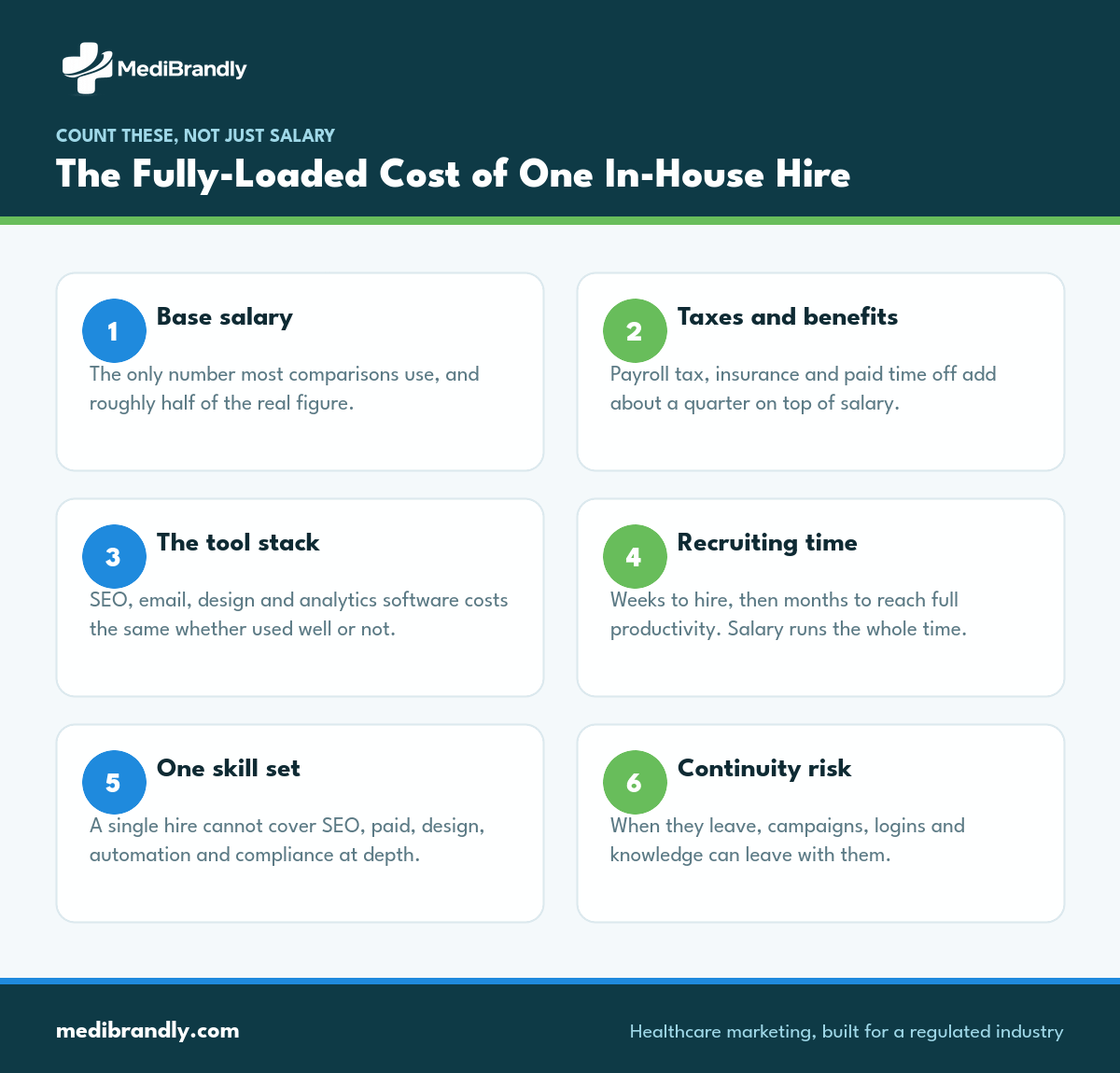
The salary is roughly half the true number. Fully loaded, a mid-level healthcare marketer looks like this:
| Line Item | Typical Annual Cost |
|---|---|
| Base salary (mid-level marketer) | $55,000–$85,000 |
| Payroll taxes and benefits (~25–30%) | $14,000–$25,000 |
| Software and tools (SEO, email, design, analytics) | $6,000–$18,000 |
| Recruiting and onboarding (amortized) | $3,000–$8,000 |
| Training and professional development | $2,000–$5,000 |
| Fully loaded total | $80,000–$140,000 |
And that buys one person’s skill set. Healthcare marketing spans technical SEO, paid media, content, design, automation and compliance — a range no single hire covers at senior level in all areas. The gaps get filled with freelancers or left undone.
Not sure which model fits your stage? Compare your options on a call — we’ll map your goals against the real cost of each path, including staying in-house.
What Does an Agency Actually Cost?
A healthcare-specialist agency typically runs $2,500–$8,000 per month for a single-location practice, which is $30,000–$96,000 per year. That range buys a team rather than a person: a strategist, SEO and paid specialists, a designer, and a compliance-aware process, with the tool stack included.
The trade you are making is proximity for coverage. An agency knows your practice less intimately than an employee who sits in your office, but it brings several specialisms at once and does not take vacation, quit, or need to be recruited. For the full agency pricing picture, see our healthcare marketing cost breakdown.
Capability Comparison: Where Each Model Is Strong
| Capability | Solo In-House Hire | Specialist Agency | Hybrid |
|---|---|---|---|
| Daily availability | ✅ Excellent | ⚠️ Scheduled | ✅ Coordinator on-site |
| Institutional knowledge | ✅ Deep | ⚠️ Learned over time | ✅ Retained internally |
| Breadth of specialisms | ❌ One person’s range | ✅ Full team | ✅ Full team |
| Technical SEO depth | ⚠️ Varies | ✅ Dedicated | ✅ Dedicated |
| Paid media management | ⚠️ Varies | ✅ Dedicated | ✅ Dedicated |
| Compliance and clinical review | ❌ Rarely in one hire | ✅ Built into process | ✅ Built into process |
| Continuity if someone leaves | ❌ Single point of failure | ✅ Team absorbs it | ✅ Team absorbs it |
| Cost to scale up or down | ❌ Hire or fire | ✅ Adjust scope | ✅ Adjust scope |
The single biggest in-house risk is not cost — it’s concentration. When your one marketer leaves, institutional knowledge, active campaigns and login access can walk out the door at once.
The Hidden Costs Neither Sticker Price Shows
Both models carry costs that never appear in the salary or the retainer, and they explain why the cheaper-looking option often isn’t.
The ramp-up gap. A new in-house hire takes two to three months to recruit and another two to three to become fully productive. That’s up to half a year of salary before the role produces at full capacity. An agency is producing in week one, but takes its own weeks to learn your market.
The coverage gap. When your one marketer is on vacation, out sick, or between roles, marketing simply stops. An agency team absorbs absences without the work pausing.
The tooling floor. The software an in-house marketer needs — SEO platform, email system, design tools, analytics, call tracking — runs $6,000–$18,000 a year regardless of how well it’s used. Agencies spread that cost across clients, so it’s already inside the retainer.
The management load. An in-house hire needs managing, reviewing and developing. That’s real time from an owner or office manager who is not a marketer, and it rarely gets counted.
None of these make in-house wrong. They just mean the true comparison is fully-loaded cost against fully-loaded cost, not salary against retainer.
When In-House Genuinely Wins
Bring it in-house when three conditions hold together:
- Your volume justifies a full-time role. Enough consistent work that a person is busy and productive every week, not searching for things to do.
- You need daily, embedded availability. A practice running frequent events, promotions, or time-sensitive content benefits from someone in the building.
- Your channel needs are narrow. If your marketing is genuinely one or two channels — say local SEO and social — one strong generalist can own them well.
Multi-location groups and larger practices often reach the scale where an in-house team (not a solo hire) becomes efficient, usually paired with an agency for specialist execution.
Weighing a first marketing hire against an agency retainer? We’ll give you a straight recommendation for your situation, even when that recommendation is “hire in-house.” Book a free consultation →
When an Agency Genuinely Wins
Choose an agency when:
- You need several specialisms at once and cannot justify hiring several people.
- Compliance and measurement expertise matter more than daily presence — the two areas generalist hires most often lack.
- You want to start producing quickly without a two-to-three-month recruit-and-onboard cycle.
- Your needs fluctuate and you value scaling scope up or down over carrying fixed headcount.
The questions to ask before signing any agency — ownership, reporting, clinical review, exit terms — are covered in our guide to choosing a healthcare marketing agency.
Why Hybrid Is the Answer for Most Practices
Above roughly $10,000 in monthly marketing activity, the strongest model is usually neither pure option.
A hybrid puts one in-house coordinator in charge of brand, content input, internal alignment and vendor management — the things that benefit from institutional knowledge and daily presence. An agency supplies the specialist execution: technical SEO, paid media, design and compliant measurement. The coordinator is the single point of accountability internally; the agency is the depth.
This resolves the core tension. You get embedded ownership without paying five salaries for five specialisms, and you get specialist depth without losing internal knowledge. It’s also resilient: neither a departing employee nor a changed agency takes everything with them.
If you’re deciding how to structure this, that’s exactly what a strategy and consulting conversation is for — and the budget benchmarks by specialty help size the total investment.
Frequently Asked Questions
Is it cheaper to hire in-house or use an agency?
For a single location, an agency is usually cheaper on a fully-loaded basis: $30,000–$96,000 per year versus $80,000–$140,000 for one loaded in-house hire. The agency also covers more specialisms, while the in-house hire covers one person’s range.
What does an in-house healthcare marketer really cost?
Fully loaded — salary, benefits, tools, recruiting and training — a mid-level healthcare marketer runs $80,000–$140,000 annually. The base salary is roughly half of the true cost.
Can one in-house marketer do everything a practice needs?
Rarely. Healthcare marketing spans technical SEO, paid media, content, design, automation and compliance. One person seldom performs all of these at a senior level, so gaps get filled with freelancers or left unaddressed.
When should a practice hire in-house instead of using an agency?
When there is enough consistent work for a full-time role, you need daily embedded availability, and your channel needs are narrow enough for one strong generalist to own. Larger groups may justify a full in-house team.
What is a hybrid marketing model?
An in-house coordinator owns brand, content and internal alignment, while an agency supplies specialist execution like SEO, paid media and compliant measurement. It’s usually the best value above about $10,000 in monthly marketing activity.
Does an agency understand my practice as well as an employee?
Not initially — an employee has deeper day-to-day context. A good agency closes that gap through onboarding and regular communication, and offsets it with specialist depth and continuity that a single hire cannot match.
Get a Straight Recommendation for Your Situation
The right answer depends on your volume, your specialty, and how many marketing channels you actually need running at once. There is no universally correct choice — only the correct choice for your stage.
We’ll walk through the real numbers for your practice, including the case for hiring in-house, and give you an honest recommendation you can act on.
Compare your options on a call → or email info@medibrandly.com. You can also explore strategy and consulting or read more about our team.