
The fastest way to get more Google reviews is to ask every patient, every time, through a simple automated request sent right after their visit. The catch for healthcare is that the request and your responses must stay inside HIPAA and FTC rules — which is exactly where most practices trip.
Reviews aren’t just social proof anymore; a steady flow of recent reviews is a genuine local ranking signal. This guide covers how to earn them systematically, the templates that work, and the compliance lines you cannot cross.
Why Do Reviews Matter for Ranking and Bookings?
Reviews do two jobs at once: they influence your local search prominence, and they’re often the deciding factor when a patient chooses between you and a competitor. Recency and consistency carry real weight — an active stream of reviews signals a thriving practice in a way a large but stale total does not.
For the patient, the math is simple. Faced with two nearby practices, most people pick the one with more recent, better-answered reviews. You’re not just ranking for Google; you’re winning the three-second comparison a patient makes in the map pack. For how that fits the wider local picture, see our local SEO guide for doctors.
Not sure if your review process is compliant? Request a free review-workflow audit — we’ll check how you ask, how you respond, and whether anything you’re doing risks an FTC or HIPAA problem, then hand you a safe, automated system.
How Do I Ask for Reviews Without Breaking HIPAA?
Ask everyone the same way, keep the request generic, and never reveal health information in the process. HIPAA doesn’t forbid asking for reviews — it forbids disclosing protected health information, so the request itself must not reference a condition, treatment, or anything that identifies why the person was seen.
A compliant request workflow looks like this:
- Ask at the right moment — right after a positive visit, while goodwill is high.
- Keep the message generic — thank them for choosing the practice and invite feedback. No mention of what they were treated for.
- Send by the patient’s preferred channel — SMS or email they’ve already agreed to receive.
- Make it one tap — link straight to your Google review page; every added step loses people.
- Ask consistently — the same simple request to every patient, not a hand-picked few.
- Log it, don’t chase it — one reminder at most, then stop.
The mechanics of doing this at scale — collecting consent, timing the send, and never storing health context in the marketing tool — is what a HIPAA-conscious CRM and automation setup handles so the front desk doesn’t have to.
What Do Compliant Review Request Templates Look Like?
Effective templates are short, warm, generic, and end in a single link. Here are two you can adapt — note that neither references any health detail:
SMS: “Hi [First name], thank you for visiting [Practice name]. If you have a moment, we’d truly appreciate your feedback — it helps other families find us: [review link]”
Email: “Dear [First name], thank you for choosing [Practice name]. Your experience matters to us, and a short review would help others in the community find care they can trust. It takes about a minute: [review link]. Thank you — the team at [Practice name].”
Keep them personal in tone but neutral in content. The name and practice are fine; the reason for the visit is not.
Is Review Gating Allowed?
No. “Review gating” — screening patients first and only inviting the happy ones to post publicly — is treated as deceptive under the FTC’s rules on reviews and endorsements, because it manufactures a misleading picture of your reputation. The FTC’s guidance on reviews and endorsements is the authority here, and enforcement in this area has grown.
Ask everyone, not just the satisfied. It feels riskier, but a review profile with a few thoughtful critical reviews and genuine responses reads as more trustworthy than a suspiciously perfect one — and it keeps you clear of an FTC problem. This guidance is general information, not legal advice; confirm specifics with counsel.
| Practice | Compliant? | Why |
|---|---|---|
| Asking every patient for a review | Yes | Consistent, non-selective |
| Only asking patients you know are happy | No | Review gating — deceptive under FTC guidance |
| Generic thank-you request with a review link | Yes | No health information disclosed |
| Mentioning the treatment in the request | No | Risks disclosing PHI |
| Offering a discount for any review | Risky | Incentivized reviews must be disclosed and unbiased; avoid |
| Responding without confirming patient status | Yes | Protects PHI in a public setting |
How Do I Respond to a Negative Review Compliantly?
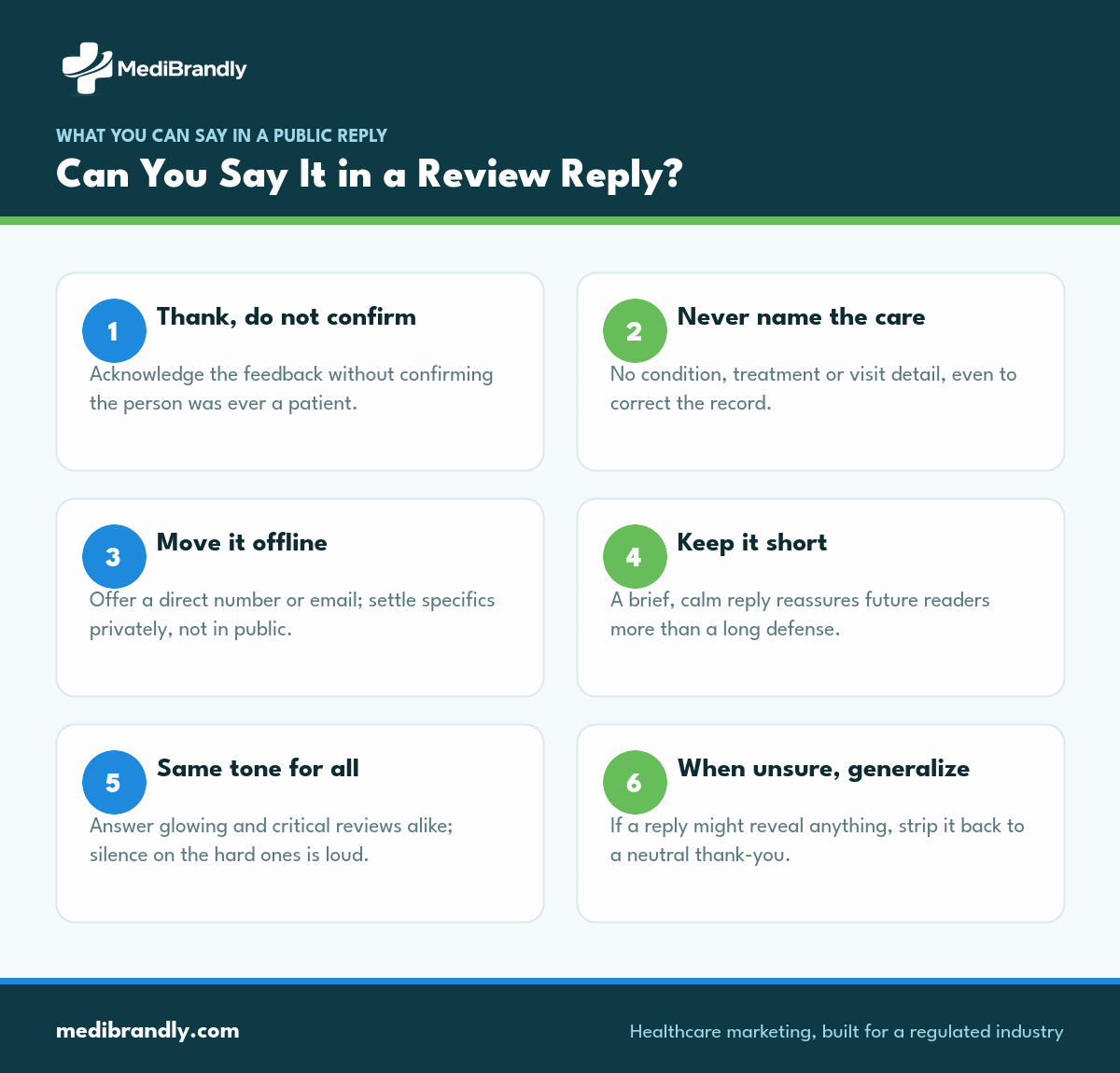
Respond, but never confirm the person was a patient or reference any health detail — even to defend yourself. In a public reply, acknowledging that someone was treated at your practice can itself be a HIPAA disclosure, regardless of what the reviewer already revealed.
The safe pattern: thank them for the feedback, express that you take concerns seriously, and move the conversation offline with a phone number or email. Keep it brief, professional, and free of specifics. Under HHS guidance on the HIPAA Privacy Rule, the reviewer can say what they like about their own care — you cannot. A calm, generic, offline-inviting response also reassures every future patient reading it far more than an argument would.
How Do I Make This Happen Every Time?
Automate the request so it fires after every eligible visit without anyone remembering to send it — consistency is the whole game, and manual asking always decays. The practices that win at reviews aren’t more charming; they have a system that never forgets.
Connect the request to your patient flow, keep the message generic and consent-based, and feed the results into your reporting so you can see review velocity as a metric you manage. That measurement lives alongside your other outcomes in analytics and reporting, and the automation itself runs through your CRM and marketing automation.
Want reviews on autopilot — safely? We build the compliant, automated request-and-response system that turns satisfied patients into a steady stream of recent reviews. Book a free consultation →
Frequently Asked Questions
How do I get more Google reviews for my medical practice?
Ask every patient consistently through a short, generic, automated request sent right after their visit, with a one-tap link to your Google review page. Volume comes from a reliable system, not from asking a hand-picked few.
Is asking patients for reviews a HIPAA violation?
No. Asking for a review is allowed. What HIPAA prohibits is disclosing protected health information, so the request must stay generic — never referencing the condition, treatment, or reason for the visit — and it should go only to patients who’ve agreed to be contacted.
Can I offer a discount or gift for leaving a review?
It’s risky. Incentivized reviews must be unbiased and clearly disclosed, and offering rewards only for positive reviews is deceptive. Most practices are safest not incentivizing reviews at all and simply asking everyone.
What is review gating and why is it a problem?
Review gating is screening patients and inviting only the happy ones to post publicly. The FTC treats it as deceptive because it creates a misleading impression of your reputation. Ask all patients, not just satisfied ones.
How should I respond to a negative review as a medical practice?
Thank the reviewer, express that you take concerns seriously, and invite them to continue offline. Never confirm they were a patient or mention any health detail — doing so can itself be a HIPAA disclosure, even in response to what they’ve posted.
How many reviews does my practice need?
There’s no fixed target. Recency and a steady flow matter more than a single large number, because active reviews signal an active practice. Focus on consistently earning new reviews rather than hitting a milestone.
Build a Review Engine That Stays Compliant
More reviews mean better local ranking and more patients choosing you — but in healthcare, the wrong request or response can create real liability. The answer is a system that asks everyone, stays generic, and responds safely, every time.
We’ll audit how you currently gather reviews, remove any compliance risk, and build the automated workflow that keeps recent reviews coming.
Request your free review-workflow audit → or email info@medibrandly.com. You can also explore CRM and marketing automation or see results in our case studies.