
Three things decide where a practice ranks in the Google Maps results: relevance (does your profile match the search), distance (how close you are to the searcher), and prominence (how established and trusted you look). You can’t move your building, so relevance and prominence are where the work is.
Most practices lose the local pack not because a competitor is better, but because their own Google Business Profile is incomplete, their reviews have gone quiet, and their name, address and phone number don’t match across the web. This guide fixes all three.
What Actually Decides Google Maps Rankings for a Medical Practice?
Google ranks local results on relevance, distance and prominence — and for a searcher on a phone, distance carries real weight. That’s why a smaller nearby practice often outranks a larger one across town. You influence the other two by making your profile unmistakably complete and your reputation visibly active.
| Ranking factor | What it means | What moves it |
|---|---|---|
| Relevance | How well your profile matches the search | Correct primary category, services listed, complete profile |
| Distance | Proximity to the person searching | Fixed — but service-area and location pages help nearby searches |
| Prominence | How well-known and trusted you appear | Review volume and recency, citations, website authority, links |
The practical takeaway: you win local by being the most complete, most consistent, and most actively-reviewed option inside the radius Google is searching — not by being the biggest name in the city.
Not showing up in the map pack? Request a free local visibility audit — we’ll check your Google Business Profile, review velocity, and citation consistency, and show you exactly what’s holding your ranking back.
How Do I Optimize My Google Business Profile?
Your Google Business Profile is the single biggest local ranking lever, and most practices fill out half of it. A complete, accurate profile is the price of entry for the map pack. Work through it in this order:
- Claim and verify the profile, and make sure only the practice controls it — not a former vendor.
- Set the correct primary category. “Medical clinic” and “Dermatologist” are different searches. Your primary category should match your core service exactly; add secondary categories for the rest.
- Complete every field — name, address, phone, hours, website, appointment link, and a real description. Empty fields signal an inactive listing.
- List your services individually, using the words patients actually search for.
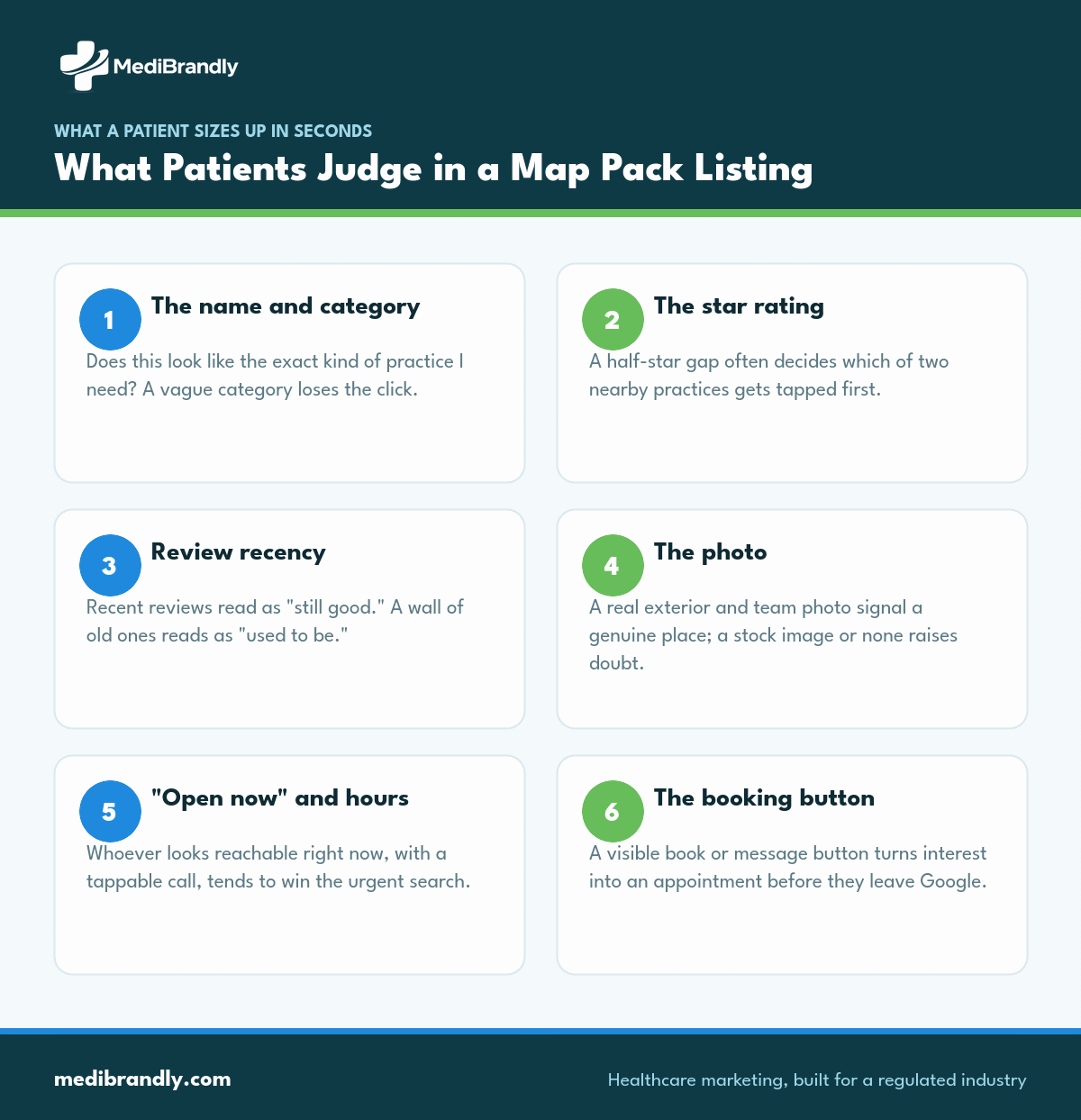
- Add real photos of the building exterior, interior, and team. The exterior helps patients find you and signals a genuine location.
- Add each provider and keep hours accurate, including holidays. Wrong hours are a common, silent trust-killer.
- Turn on messaging or a booking link so an interested patient can act inside the listing.
- Keep the name clean. Your Business Profile name should be your real practice name — stuffing keywords into it violates Google’s guidelines and risks suspension.
Google’s own Business Profile Help documents the rules; staying inside them is what keeps a hard-won listing from being suspended. For the step-by-step field-by-field version, see our dedicated Google Business Profile checklist.
Why Do Reviews Matter So Much for Local Ranking?
Reviews influence prominence, and recency matters as much as volume — a steady flow of recent reviews signals an active, trusted practice. A profile with 200 reviews and nothing in the last six months looks stale next to one earning a few every week.
The mechanics that matter:
- Velocity over total. A consistent trickle beats a one-time burst.
- Responses. Reply to every review, positive and negative — it signals an engaged practice and is visible to future patients.
- Compliance. Never confirm someone was a patient in a public reply, and never gate reviews (asking only happy patients) — the FTC treats review gating as deceptive. The compliant workflow is covered in our guide to getting more Google reviews.
Reviews are earned through a system, not luck — usually an automated, HIPAA-safe request sent after a visit through your CRM and marketing automation.
What Are Citations and NAP Consistency?
A citation is any online mention of your practice’s Name, Address and Phone number (NAP) — in directories, health listings, and data aggregators. Google reads consistency across these as a confidence signal. When your address is formatted three different ways across the web, that confidence drops.
Fix citations in priority order:
- Google Business Profile first — it’s the source of truth patients and Google both check.
- The major data aggregators and health directories — get the core NAP identical everywhere.
- Kill duplicates. Two profiles for the same location split your signals and confuse patients; merge or remove them.
The goal is boring on purpose: the exact same practice name, the exact same address format, and the same phone number, everywhere.
How Do Multi-Location Practices Rank in Every City?
Each location needs its own Google Business Profile and its own dedicated page on your website — one URL per location, with that location’s address, providers, hours and locally relevant content. A single “Locations” page listing all of them will not rank each one.
For groups, the pattern is a location page per site, each linked from a clean location hub, each with its own embedded map and local details. This is its own discipline at scale, and it’s what our multi-location practice marketing work is built around. Trying to rank ten clinics from one page is the most common — and most expensive — local SEO mistake groups make.
What Local Schema Should a Medical Website Use?
Add structured data that tells search engines you are a physical, local medical business: your name, address, phone, geo-coordinates, hours and the services you provide. This helps engines connect your website to your Business Profile as the same entity, reinforcing prominence.
Paired with consistent citations, schema is how your site, your profile and your directory listings all agree on who and where you are — the “agreement” that local ranking quietly rewards. It’s part of the same structured-data work that helps you get surfaced in AI answers; see our guide to getting cited in Google AI Overviews.
How Do I Track Whether Local SEO Is Working?
Track the outcomes that map to revenue, not vanity metrics. Ranking position matters only insofar as it produces calls and booked appointments.
Watch three things: map pack visibility for your core services in your area, calls and direction requests from the Business Profile, and booked appointments attributed to local search. Call tracking that stays HIPAA-safe is what closes the loop between “we ranked” and “we got the patient” — and it’s what separates local SEO you can prove from local SEO you just hope is working. That measurement is the backbone of our healthcare SEO services.
Managing local SEO across one location or twenty? We build the profile, review, citation and tracking system that ranks practices in the map pack and proves it in booked visits. Book a free consultation →
Frequently Asked Questions
How long does local SEO take to work for a medical practice?
Google Business Profile optimizations can show movement within a few weeks, but building durable prominence through reviews, citations and website authority typically takes three to six months. Competitive urban markets take longer than smaller towns.
How do I rank in the Google Maps 3-pack?
Optimize for relevance, distance and prominence: a complete, correctly-categorized Business Profile, a steady flow of recent reviews, consistent name-address-phone citations across the web, and a strong location page on your site. There is no single trick — it’s the sum of these.
Does my practice need a Google Business Profile for every location?
Yes. Each physical location needs its own verified Business Profile and its own website location page. A single profile or a combined page cannot rank each location in its own city.
Can I put keywords in my Google Business Profile name to rank better?
No. Adding keywords or location terms that aren’t part of your real practice name violates Google’s guidelines and can get the listing suspended. Use your true business name and rank through categories, services and reviews instead.
How many Google reviews do I need to rank?
There is no fixed number. Recency and consistency matter more than a total — a practice earning reviews every week generally signals more prominence than one with a large but stale count. Focus on a steady, compliant request workflow.
What is NAP consistency and why does it matter?
NAP stands for Name, Address and Phone number. When these match exactly across your website, Business Profile and directory listings, search engines have more confidence in your location. Inconsistent formatting weakens that signal and can suppress local rankings.
Get Found by Patients Searching Nearby
Ranking in the map pack is the difference between a patient booking with you or with the practice two blocks away. It comes down to a complete profile, active reviews, consistent citations, and a site that proves you’re the local authority.
We’ll audit your local presence, fix what’s holding you back, and build the system that keeps you visible — then track it through to booked appointments.
Request your free local visibility audit → or email info@medibrandly.com. You can also explore healthcare SEO services or see results in our case studies.