
Telehealth marketing is a scale problem: you’re acquiring patients in many states at once, each with its own licensing, search competition, and rules about what you can claim. The brands that grow build a location architecture search engines trust, keep their claims inside each state’s lines, and know their unit economics cold.
Virtual care removes geography as a limit on who you can treat — but only if your marketing can be found in every market and stay compliant in each. This guide covers the multi-state SEO, the licensing-aware messaging, and the CAC/LTV math that separates telehealth brands that scale from those that just spend.
How Do Telehealth Brands Rank in Multiple States?
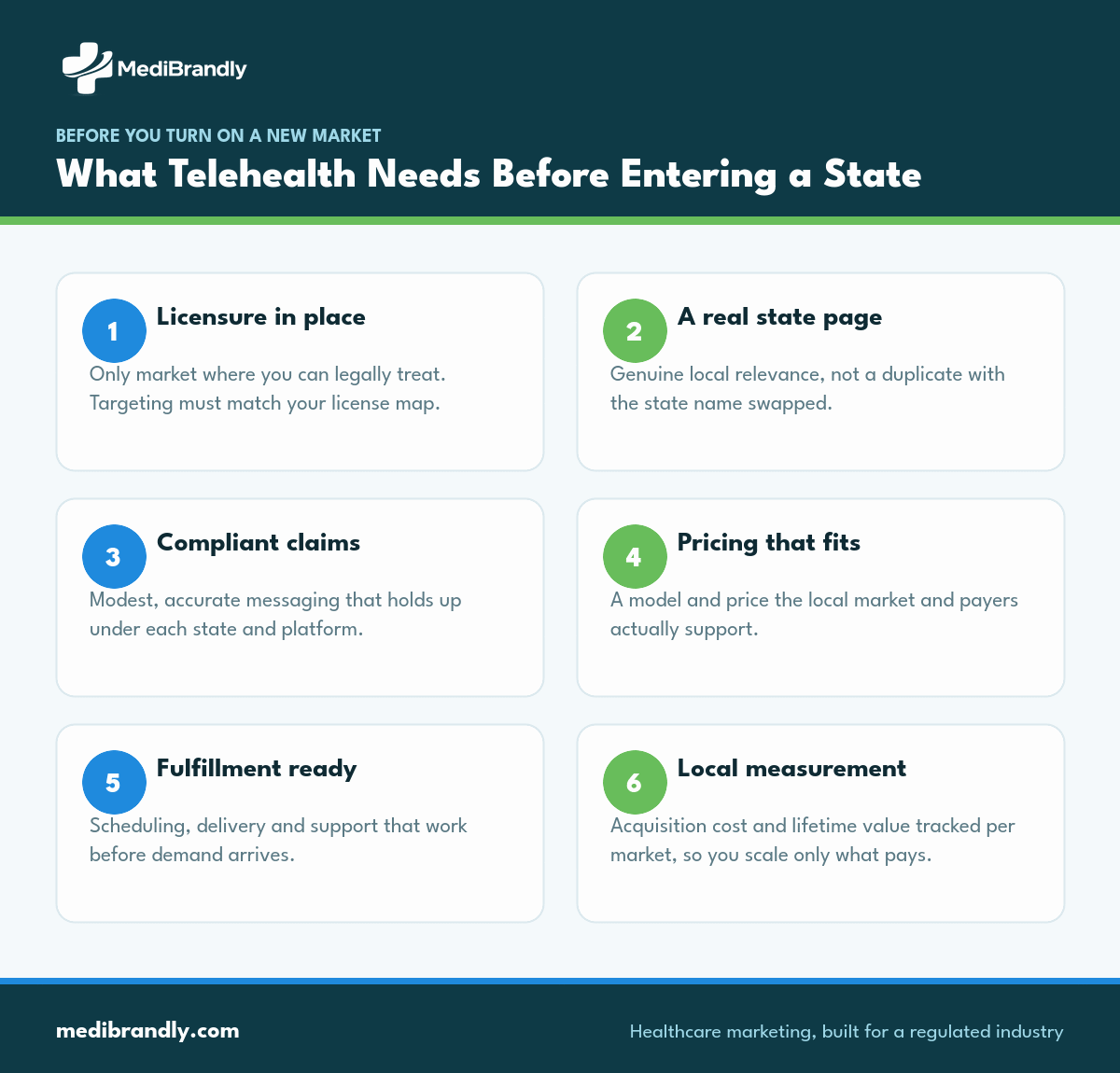
Build a dedicated, genuinely useful page for each state you’re licensed to operate in — real local relevance, not duplicated text with the state name swapped. Search engines reward a trustworthy location architecture and penalize thin, templated pages, so this is where multi-state telehealth SEO is won or lost.
Each state page should reflect actual licensure, the services available there, and content relevant to that market. Combined with strong core service pages and topical authority, this lets one brand rank across many states without diluting itself. It’s the same discipline behind our telehealth marketing work — and it’s what stops a fifty-state footprint from collapsing into fifty near-identical pages Google ignores.
Scaling across states and struggling to rank in each? Request a free telehealth growth audit — we’ll assess your multi-state SEO architecture, licensing-aware messaging, and acquisition economics, and map the fastest path to compliant growth.
What Are the Licensing and Advertising Constraints?
You can only market services where you’re licensed to deliver them, and your claims must stay accurate for each state and channel. Telehealth sits at the intersection of state medical-practice rules and platform ad policies, so messaging that’s fine in one context can be a problem in another.
Keep three principles front of mind:
- Market only where you can treat. Advertising a service into a state where you aren’t licensed invites regulatory and platform trouble.
- Keep claims accurate and modest — no guaranteed outcomes, no overstated scope of care.
- Respect category-specific rules. Sensitive services like mental health carry extra requirements, covered in our mental health marketing guide.
Getting this right across dozens of markets is a compliance-and-operations problem as much as a creative one, which is why we build it into campaign structure from the start.
Subscription vs Per-Visit: How Should Pricing Shape Marketing?
Your model dictates your metric: subscription telehealth markets for retained members and lifetime value, while per-visit care markets for volume and repeat episodes. The pricing model isn’t just a billing choice — it determines which numbers your marketing must move.
| Subscription telehealth | Per-visit telehealth | |
|---|---|---|
| Core metric | Retention and lifetime value | Volume and repeat episodes |
| Acquisition budget | Higher cost justified by long lifetime value | Efficient, repeatable acquisition |
| Marketing focus | Onboarding, engagement, retention | Reasons to return, easy re-booking |
| Risk if misaligned | Chasing volume erodes margin | Over-investing in retention that won’t compound |
A subscription brand should invest in onboarding, engagement and retention, because a member who stays for months or years justifies a higher acquisition cost. A per-visit brand needs efficient, repeatable acquisition and reasons for patients to return. Marketing the wrong metric — chasing volume for a retention model, or retention for a one-off model — is how telehealth budgets get wasted. Aligning the two is a core part of our CRM and marketing automation work.
How Do I Calculate CAC and LTV for Telehealth?
Track customer acquisition cost (CAC) against lifetime value (LTV) by channel — telehealth lives or dies on this ratio, because you’re often acquiring at scale before revenue catches up. If a channel costs more to acquire a patient than that patient is worth, growth just accelerates losses.
The discipline: measure fully-loaded acquisition cost per channel, measure realistic lifetime value by model, and only scale channels where LTV comfortably exceeds CAC. This is where telehealth overlaps with healthcare SaaS marketing — both are subscription-economics businesses — and it’s why we treat measurement as infrastructure, not a report. Without it, a telehealth brand can look like it’s growing while quietly burning money on every patient.
What Do Telehealth Acquisition Funnels Look Like?
Most telehealth funnels run through two doors: the web, for research and sign-up, and the app store, for brands with a native app. Each needs its own optimization, and the handoff between them has to be frictionless or patients drop out mid-signup.
The web funnel earns trust and captures intent through search and content; the app funnel depends on store presence, ratings and a frictionless onboarding. The brands that scale reduce every unnecessary step between “interested” and “first visit,” because in virtual care the whole journey happens in minutes and any friction costs a patient. Mapping and tightening that path is where acquisition and retention meet.
Ready to acquire patients across every state you serve? We build the multi-state SEO, compliant messaging and measurable funnels that let virtual care brands scale without burning budget. Book a free consultation →
Frequently Asked Questions
How do telehealth companies market across multiple states?
By building a dedicated, genuinely useful page for each licensed state, supported by strong service pages and topical authority. Real local relevance — not duplicated text — lets one brand rank in many markets. Marketing must stay within the states where the brand is licensed to treat.
Can I advertise telehealth services in states where I’m not licensed?
No. You should only market services where you’re licensed to deliver them. Advertising into a state where you can’t legally treat patients invites regulatory scrutiny and platform ad disapprovals, so campaign targeting must match your actual licensure map.
How do I calculate customer acquisition cost for telehealth?
Measure the fully-loaded cost of each channel divided by the patients it produces, then compare that to realistic lifetime value by your pricing model. Scale only the channels where lifetime value comfortably exceeds acquisition cost, or growth will accelerate losses.
Should a telehealth brand use subscriptions or per-visit pricing?
Both models work, but they demand different marketing. Subscriptions reward investment in onboarding, engagement and retention because members have high lifetime value. Per-visit care needs efficient, repeatable acquisition and reasons to return. Market the metric your model actually depends on.
How is telehealth marketing different from a physical clinic?
Telehealth removes geography but adds multi-state complexity: many markets, many licensing rules, and subscription-style economics. It relies more on scalable SEO architecture, app and web funnels, and rigorous CAC/LTV measurement than on the single-location local SEO a physical clinic depends on.
What makes a telehealth landing page convert?
A frictionless path from interest to first visit: clear service and eligibility information, trust signals, transparent pricing, and the fewest possible steps to sign up. Because the entire journey can happen in minutes, every unnecessary field or page costs conversions.
Scale Virtual Care Without Scaling Waste
Telehealth’s promise is reach without geographic limits — but that reach only pays off if you can be found in every market, stay compliant in each, and prove your acquisition economics work.
We’ll build the multi-state SEO, licensing-aware messaging and measurable funnels that let your virtual care brand grow profitably.
Request your free telehealth growth audit → or email info@medibrandly.com. You can also explore telehealth marketing or see results in our case studies.