
The therapy practices that stay full in 2026 do three things: they own their local search presence, they publish content that reassures an anxious searcher, and they make the first step effortless. Directories help you start; your own website is what compounds.
Demand for mental health care is high, but so is competition and platform sensitivity. This guide covers where clients actually come from, the advertising rules specific to mental health, and how to convert visitors who are nervous, private, and comparing several providers at once.
What Marketing Works for Therapy Practices Now?
The most reliable caseload comes from being findable where people search — local search and your own optimized website — supported by directories and, where appropriate, paid ads. No single channel fills a practice; the durable ones layer local SEO, content and reputation so referrals compound over time.
Directories get you visibility quickly, but you rent that audience. Your own site, ranking for the concerns clients search and the areas you serve, is the asset you own. The strongest practices use directories for reach while building the site and reviews that let them stop depending on anyone else’s platform. For the local foundation, start with our local SEO guide for doctors.
Struggling to keep your caseload full? Book a free caseload-growth consultation — we’ll map where your ideal clients are searching, audit your visibility against local competitors, and show you the fastest path to steady referrals.
Directories vs Your Own Website: Where Should I Invest?
Use directories for early reach and your own website for long-term growth — they solve different problems. A directory profile can produce inquiries this month; a well-built website produces them for years and doesn’t raise a competitor’s listing above yours.
The tradeoff is control. On a directory you compete on someone else’s terms, beside every other therapist, and the platform owns the relationship. On your own site you control the message, capture the client directly, and build search authority that keeps working. The right answer for most practices is both, weighted toward the site over time. That site work — pages that rank for what clients search — is the core of our mental health marketing programs.
| Directory profile | Your own website | |
|---|---|---|
| Time to first inquiry | Fast | Slower to build |
| Who owns the client | The platform | You |
| Cost over time | Ongoing rent | Compounds into an asset |
| Search authority | Builds the directory’s | Builds yours |
| Message control | Limited, templated | Full |
What Are the Advertising Rules for Mental Health?
Advertising platforms treat mental health as a sensitive category, which limits how you can target and what you can claim. Google’s personalized advertising policy restricts targeting based on inferred mental health status, so ads generally can’t be personalized around that sensitivity — they reach intent through the search terms themselves instead.
Practical implications:
- Target the search, not the person. Paid search works because someone is actively looking; you’re answering a query, not profiling a condition.
- Keep claims careful. Avoid guarantees of outcomes; describe your approach and who you help.
- Mind separate rules for adjacent services. Some categories — notably addiction treatment — carry their own certification requirements, covered in our addiction treatment marketing guide.
Get the compliance framing right and paid search becomes a dependable intake channel; get it wrong and campaigns get disapproved. That’s why we run it as paid search and PPC with the policy built in.
What Content Converts an Anxious Searcher?
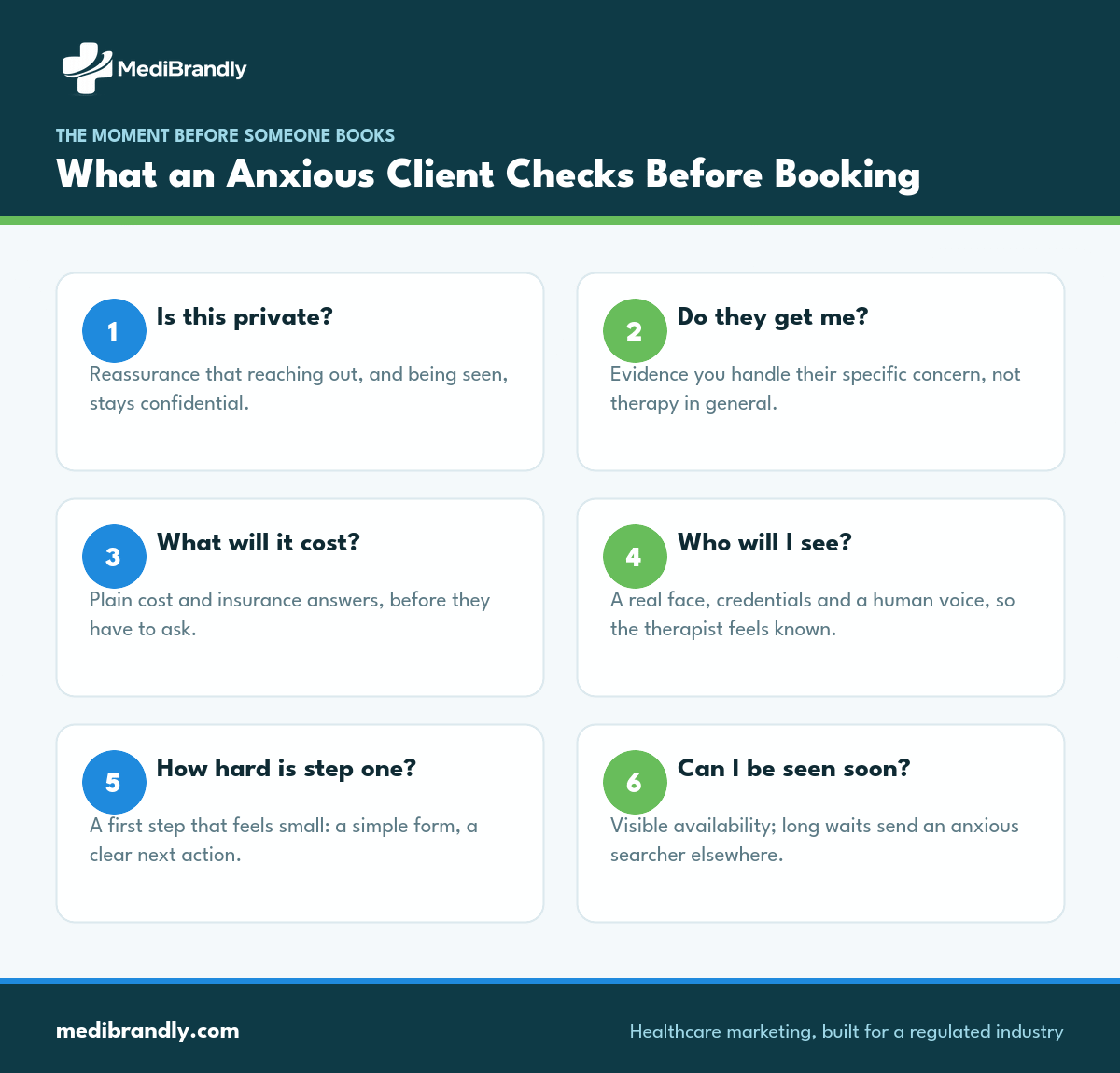
Content converts when it reduces uncertainty — about privacy, fit, cost, and what the first session is actually like. Someone searching for therapy is often nervous and comparing several providers; the practice that answers their unspoken questions first tends to win the booking.
The pages and posts that work, in priority order:
- “What to expect” content that demystifies the first session and the process.
- Approach and specialization pages so a client can see you handle their specific concern.
- Clear cost and insurance information — one of the most-searched, least-answered questions.
- Real therapist bios with photos, credentials and a human voice, so the client feels they’ve already met you.
This is E-E-A-T and reassurance working together, and it’s the same trust-building that helps you get surfaced when people ask AI engines for help; see our guide to getting cited in Google AI Overviews.
How Do Teletherapy Practices Market Across States?
Build a dedicated, genuinely useful page for each state you’re licensed in, with content relevant to that state — not thin duplicates. Multi-state teletherapy lives or dies on a location architecture search engines can trust and clients find.
Each state page should reflect real licensure and local relevance rather than a find-and-replace of the state name. Combined with clear service pages, this lets one practice serve many markets without diluting its authority. It’s the same multi-market discipline behind our telehealth marketing work, and it applies whether you’re a solo teletherapist or a group spanning several states — including psychology and psychiatry practices with different regulatory footprints.
How Do I Measure Marketing Without Compromising Privacy?
Measure outcomes — inquiries, booked intakes, kept appointments — using tracking that never exposes who a client is or why they reached out. Mental health data is especially sensitive, so attribution has to be built to avoid leaking anything identifiable to advertising platforms.
The goal is to know which channels produce clients without ever attaching a person to a condition in your analytics. Done right, you get clear ROI and stay clear of privacy problems — the balance our analytics and reporting work is designed around. It’s the difference between measuring your marketing and creating a liability while you do it.
Ready to build a referral engine that keeps your caseload full? We combine local SEO, reassuring content, compliant ads and private-by-design measurement for therapy and counseling practices. Book a free consultation →
Frequently Asked Questions
How do therapists get more clients in 2026?
By owning local search and their own website, supported by directories and, where appropriate, compliant paid search. Reassuring content, real therapist bios, clear cost information and an effortless first step convert the anxious, comparison-driven searchers that mental health marketing has to reach.
Are online directories worth it for therapy practices?
They’re useful for early reach and quick inquiries, but you rent that audience. Directories work best alongside your own website, which you own and which builds lasting search authority. Over time, weight your investment toward the site and your reviews.
Can I run Google Ads for a therapy practice?
Yes, but mental health is a sensitive category with targeting restrictions — you generally can’t personalize ads around inferred mental health status. Paid search still works well because it responds to what someone is actively searching, and careful, claim-safe copy keeps campaigns approved.
How do I market teletherapy across multiple states?
Create a genuine, useful page for each state you’re licensed in, reflecting real local relevance rather than duplicated text. A trustworthy location architecture lets one practice serve many markets without diluting its search authority or misrepresenting licensure.
What should a therapy website include to convert clients?
“What to expect” content, clear specialization and approach pages, transparent cost and insurance information, and authentic therapist bios with photos and credentials. Each element reduces the uncertainty that keeps an anxious searcher from booking.
How do I track therapy marketing without violating privacy?
Measure inquiries, booked intakes and kept appointments using attribution built to avoid exposing identifiable information to ad platforms. You can prove channel ROI without ever linking a person to a condition in your analytics.
Keep Your Caseload Full — Compliantly
Filling a therapy practice isn’t about being everywhere; it’s about being findable where clients search, reassuring when they arrive, and effortless when they’re ready to book — all without compromising the privacy that mental health demands.
We’ll build the local presence, content and measurement that bring a steady stream of the right clients to your door.
Book your free caseload-growth consultation → or email info@medibrandly.com. You can also explore mental health marketing or read more about our team.