
A professional medical practice website costs $5,000–$30,000 to build, with template-based sites starting around $2,500 and hospital or multi-location systems running $50,000+. Ongoing hosting, security and maintenance typically add $100–$500 per month.
The spread comes down to three things most quotes never itemize: secure form handling, accessibility conformance, and whether the site is actually built to convert. Here’s what each tier buys, and which requirements are not optional.
What Drives Medical Website Pricing?
| Tier | Typical Cost | What You Get | Best For |
|---|---|---|---|
| Template / DIY | $500–$2,500 | Prebuilt theme, basic pages, self-managed | Very small practices testing an online presence |
| Semi-custom | $5,000–$15,000 | Custom design on a proven framework, secure forms, schema, on-page SEO | Most single-location practices |
| Fully custom | $15,000–$30,000+ | Bespoke design, integrations, scheduling, accessibility audit | Competitive specialties, elective procedures |
| Multi-location / system | $50,000+ | Location architecture, governance, EHR and scheduling integrations | Groups, DSOs, hospitals, MSOs |
| Ongoing (all tiers) | $100–$500/mo | Hosting, security, updates, backups, support | Everyone |
Four variables move a quote inside those bands: the number of unique page templates, whether patient data is collected on the site, how many systems must integrate, and whether accessibility conformance is scoped in or hand-waved.
Not sure whether your current site meets the mark? Request a free website and compliance review — we’ll check secure form handling, accessibility, speed and conversion, and tell you what actually needs fixing.
What Makes a Medical Website “HIPAA-Compliant”?
A useful clarification first: HIPAA does not certify websites. There is no official badge, and any vendor selling a “HIPAA-certified website” is selling a marketing term. What exists is a set of obligations that apply when your site handles protected health information.
If your website collects patient information — appointment requests with symptoms, intake forms, patient portal logins, contact forms describing a condition — then these apply:
- Encrypted transmission. HTTPS across the entire site, not just form pages.
- Secure form handling. Submissions must not sit in plain-text email or an unsecured database. This is the single most common failure we find.
- A BAA with your host and form provider. Any vendor storing or transmitting PHI on your behalf is a business associate.
- Access controls and audit logging. Who can view submissions, and a record of who did.
- Compliant tracking. Analytics and ad pixels must not transmit patient information to third parties — the constraint explained in our HIPAA marketing rules guide.
A brochure site with no forms and no patient data carries far lighter obligations than one with a portal. Scope your build accordingly rather than paying for enterprise infrastructure you don’t need — or, worse, collecting patient data on infrastructure that can’t hold it.
Accessibility: The Requirement Most Quotes Ignore
This is where the 2026 picture is genuinely confusing, and where most articles get it wrong. Three separate frameworks apply to different organizations, so the first job is knowing which one is yours.
Section 504 — recipients of HHS federal financial assistance. HHS finalised a rule requiring web content and mobile apps to meet WCAG 2.1 Level AA. In an interim final rule announced in May 2026, HHS extended the compliance dates by one year: recipients with 15 or more employees now have until 11 May 2027, and those with fewer than 15 employees until 10 May 2028. The extension changed the dates only — the standard, scope and expectations are unchanged.
ADA Title II — state and local government entities. Public hospitals, county clinics and university health systems fall here. The Department of Justice’s 2024 web rule also requires WCAG 2.1 Level AA, on deadlines set by population size. This is the framework most commonly quoted at private practices incorrectly — it does not apply to them.
ADA Title III — private practices as places of public accommodation. No specific technical standard is codified here, but private practices have faced accessibility litigation for years, and courts routinely reference WCAG as the practical benchmark.
The sensible read for most private practices: build to WCAG 2.1 Level AA regardless of which framework binds you. It’s the common standard across all three, it’s what any future obligation will be measured against, and retrofitting accessibility into a finished site costs considerably more than building it in.
In practice that means keyboard navigation, sufficient color contrast, descriptive alt text, labeled form fields, visible focus states, and captions on video. None of it is exotic; all of it is cheaper on day one. This guide is general information, not legal advice — confirm your own obligations with counsel.
Building or rebuilding a practice site? MediBrandly builds healthcare sites with secure forms, accessibility and schema handled as requirements rather than upsells. Book a free strategy consultation →
What Should Every Medical Practice Website Include?
Beyond compliance, these are the elements that determine whether the site earns appointments:
- Online scheduling above the fold, or a phone number that is tappable on mobile.
- Insurance and cost information answered plainly. Among the most-searched and least-answered questions in every specialty.
- Individual service and condition pages — one per procedure, not a single “Services” page. These are what rank and what AI engines cite.
- Named provider bios with credentials and photos. A direct E-E-A-T signal and a genuine patient trust factor.
- Schema markup — organization, provider, service and FAQ. See our guide to getting cited in Google AI Overviews for why this matters more each year.
- Speed and mobile experience. Healthcare searches skew heavily mobile and frequently urgent.
- Real photography of the practice and team. Stock imagery measurably underperforms for booking confidence.
- Clear legal notices — privacy policy, terms and accessibility statement. Ours are published as our website legal notices.
What Inflates a Website Quote
If two quotes differ by $10,000, the gap is usually in one of these — worth asking about line by line.
Page template count. Cost scales with unique templates, not total pages. Twenty service pages on one template is far cheaper than five pages each designed individually.
Integrations. Connecting scheduling, EHR, payment or a patient portal is where custom development hours accumulate fastest. Each integration is its own small project.
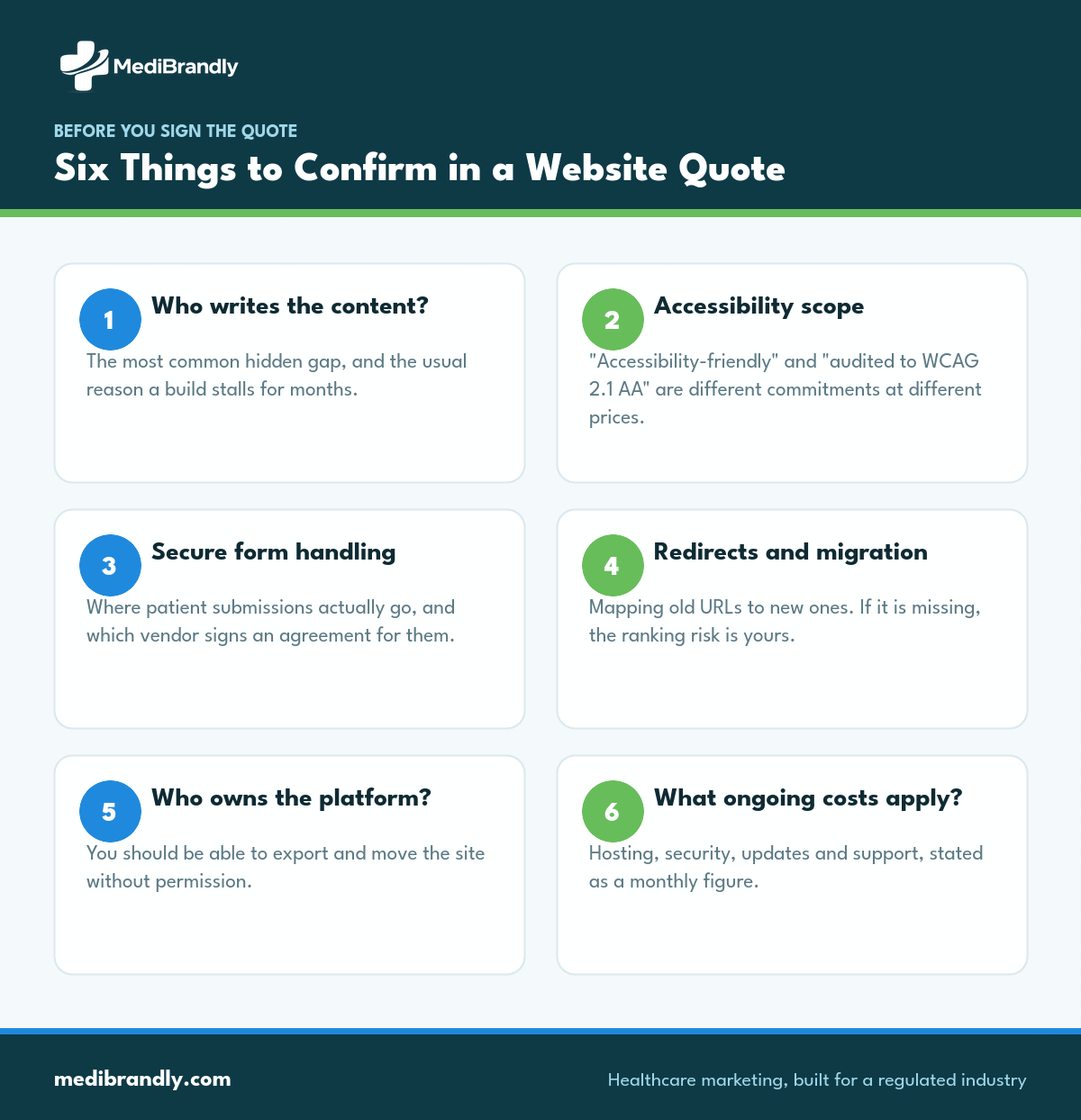
Content production. Whether the quote includes writing your service pages and provider bios, or assumes you supply everything. This is the most common hidden gap, and the most common cause of a build stalling for months.
Accessibility scope. “Accessibility-friendly” and “audited to WCAG 2.1 AA” are very different commitments at very different prices. Ask which one you’re buying.
Migration and redirects. Mapping old URLs to new ones is real work, and quotes that omit it are quietly transferring the risk to you.
Redesign or Rebuild?
A useful test: if the foundation is sound and the problem is presentation, redesign. If the foundation is the problem, rebuild.
Redesign ($5,000–$15,000) makes sense when the site is fast, secure and reasonably structured, but looks dated or converts poorly. You keep the technical base and the SEO equity.
Rebuild ($15,000–$30,000+) makes sense when the site is slow, cannot be made accessible, collects patient data insecurely, or is on a platform you cannot export from. Also when the URL structure is so poor that fixing it means rebuilding anyway.
One caution either way: a rebuild done without SEO care can erase rankings overnight. URL mapping and 301 redirects are non-negotiable, and any quote that omits them is incomplete. Where the website sits in overall spend is covered in our healthcare marketing cost breakdown.
Is an Expensive Website Worth It?
The number that matters is conversion rate, not build cost.
A site converting 3% of visitors into appointment requests versus one converting 8% is a difference of thousands of patients over the site’s life. At a conservative patient value, a $15,000 site that converts well pays back faster than a $3,000 site that doesn’t — and the cheap site quietly taxes every marketing dollar you spend driving traffic to it.
That said, spending $30,000 on a beautiful site for a practice with no traffic strategy is equally wasteful. The website is the conversion layer; it needs traffic feeding it — from what healthcare SEO actually costs or from paid search — to produce anything. Fund both, or fund neither.
Frequently Asked Questions
How much does a medical website cost?
Most practices pay $5,000–$30,000 for a professional build, with templates from $2,500 and hospital or multi-location systems above $50,000. Ongoing hosting, security and maintenance add $100–$500 per month.
Does my practice website need to be HIPAA-compliant?
If it collects patient information — intake forms, appointment requests describing symptoms, or portal logins — then yes, it must handle that data securely and under a BAA with relevant vendors. A brochure site with no patient data carries much lighter obligations.
Is there such a thing as a HIPAA-certified website?
No. HIPAA has no website certification program. Vendors advertising “HIPAA-certified” sites are using a marketing term. What matters is encryption, secure form handling, BAAs, access controls and compliant tracking.
What accessibility standard does a medical website need to meet?
WCAG 2.1 Level AA is the common benchmark. Recipients of HHS federal financial assistance have until 11 May 2027 (15+ employees) or 10 May 2028 (fewer than 15) under Section 504. Private practices should build to the same standard regardless.
How long does a medical website take to build?
A semi-custom practice site typically takes six to twelve weeks; fully custom builds run twelve to twenty weeks. Content and provider bios are usually the bottleneck, not design or development.
Will a redesign hurt my search rankings?
It can, if URLs change without proper 301 redirects and URL mapping. Done carefully, a rebuild usually improves rankings because speed, structure and content quality all improve together.
Find Out What Your Site Actually Needs
Most practice websites we review don’t need a full rebuild. They need secure forms, accessibility fixes, faster load times, and pages that answer what patients actually search for.
We’ll audit your current site against HIPAA-conscious handling, WCAG 2.1 AA, speed and conversion, then tell you honestly whether you need a redesign, a rebuild, or just a focused fix list.
Request your free website and compliance review → or email info@medibrandly.com. You can also explore healthcare web design and development or see our case studies.