
Marketing a healthcare group is a different discipline from marketing one practice: every location has to win its own local market while the organization keeps one consistent brand and one clear view of performance. Do it well and locations compound each other’s authority; do it wrong and they compete with each other and no one can tell which sites are underperforming.
Multi-location marketing is where healthcare groups, DSOs, MSOs, and private-equity-backed platforms either scale efficiently or waste budget at scale. This guide covers the architecture, the local execution, and the reporting that make it work across every clinic.
How Do You Structure a Multi-Location Website for SEO?
Give every location its own dedicated page with that location’s address, providers, hours, services, and locally relevant content — one URL per location, never a single combined page. Search engines rank pages, not organizations, so a location without its own page can’t rank in its own market.
The architecture that scales:
- A location page per site, each with unique local details and content.
- A clean location hub linking to every individual page.
- Local business schema on each page tying it to its Google Business Profile.
- Consistent templates so new locations launch fast without losing local specificity.
Trying to rank many clinics from one page is the most common and most expensive multi-location mistake. The proper structure is the foundation of our multi-location practice marketing, and the local fundamentals behind each page are in our local SEO guide.
Struggling to rank every location in its own market? Request a free multi-location marketing audit — we’ll assess your location architecture, Google Business Profiles, and per-site reporting, and show you where the group is leaving growth on the table.
How Do You Manage Google Business Profiles at Scale?
Each location needs its own verified, individually-optimized Google Business Profile — and at scale, that means a system, not ad-hoc updates. A group’s local visibility lives or dies on these profiles, and managing dozens consistently is a real operational discipline.
At scale you need consistent categories and information across profiles, a reliable process for updates and review responses, and monitoring so no location’s profile drifts or gets suspended. The payoff is that every location shows up strongly in its own map pack, which for a group is the single largest driver of local demand.
Centralized or Localized: How Should Budgets and Control Work?
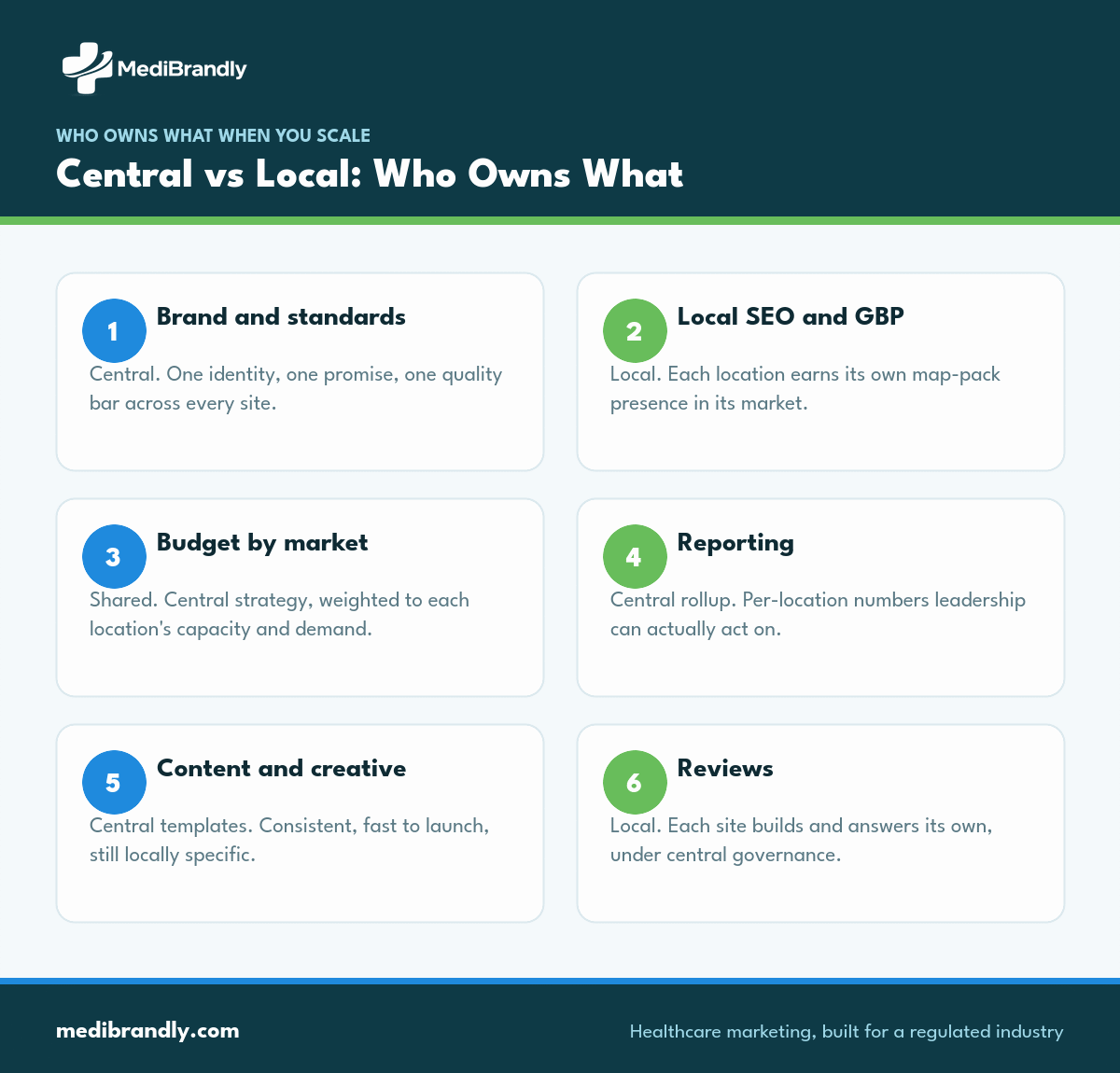
The answer is both — centralize brand, standards, and reporting; localize targeting, budgets by market, and community relevance. Pure centralization erases the local signals that drive rankings; pure localization produces an inconsistent, unmanageable brand.
| Centralize | Localize |
|---|---|
| Brand, identity, and messaging standards | Local SEO and Google Business Profile per site |
| Website platform and templates | Budget weighting by market and capacity |
| Reporting, analytics, and governance | Community relevance and local reviews |
| Compliance and creative review | Paid campaign targeting by location |
The strongest groups run a central foundation with local execution, so each clinic competes hard locally while the organization stays coherent and measurable. This balance is what our strategy and consulting work is built to design.
How Do You Keep the Brand Consistent Across Locations?
Give every location the same core identity, message, and quality standard, while allowing the local details that make each site relevant. Brand drift — where each clinic invents its own look and promises — erodes the trust and recognition that scale is supposed to build.
Central governance of brand and creative keeps the group coherent: one promise, one visual identity, one standard of patient experience, expressed consistently from the largest location to the newest. That consistency is an asset that compounds — every location reinforces the same trusted name — and it’s why we treat brand governance as core infrastructure for groups, not a nicety.
Why Does Per-Location Reporting Matter So Much?
Because you can’t manage what you can’t see by location — group-level averages hide which clinics are thriving and which are quietly failing. Per-location reporting is what lets leadership act: shift budget, fix underperformers, and prove ROI site by site.
For groups and their investors, this rollup is essential. It shows census, cost per acquired patient, and channel performance for every location and for the portfolio as a whole, turning marketing from a cost center into a measurable growth lever. That reporting is the backbone of our analytics and reporting work, and it’s especially critical for private-equity-backed platforms where marketing performance feeds enterprise value.
What Changes During M&A and Integration?
When a group acquires a practice, its marketing has to be integrated without losing the local equity that made it valuable. Careless integration — abrupt rebrands, changed URLs without redirects, lost reviews — can erase years of local trust and rankings overnight.
The disciplined path preserves what works: migrate the site with proper redirects, retain and transition the Google Business Profile and reviews, and phase any rebrand so local recognition carries over. For acquisitive platforms, this repeatable integration playbook protects the value of every deal — the kind of work that sits between marketing and choosing the right agency partner to execute it.
Scaling or integrating locations and need it done right? We build the location architecture, profile management, and per-site reporting that let healthcare groups grow every market at once. Book a free consultation →
Frequently Asked Questions
How do you do SEO for a multi-location medical practice?
Give each location its own dedicated page with unique local content, address, providers, and schema, linked from a location hub, and pair each with its own optimized Google Business Profile. Search engines rank individual pages, so every location needs its own to compete locally.
Should each clinic have its own Google Business Profile?
Yes. Every physical location needs its own verified, individually-optimized profile with that site’s details. One profile cannot rank multiple locations, and at scale you need a consistent process for updates, review responses, and suspension monitoring across all of them.
Should multi-location marketing be centralized or localized?
Both. Centralize brand, standards, reporting, and governance; localize local SEO, budget weighting, community relevance, and campaign targeting. A central foundation with local execution lets each clinic compete hard in its market while the organization stays consistent and measurable.
Why is per-location reporting important?
Group averages hide which locations are thriving and which are failing. Per-location reporting shows census, cost per acquired patient, and channel performance site by site, letting leadership shift budget, fix underperformers, and prove ROI — essential for groups and their investors.
How do you integrate marketing after acquiring a practice?
Preserve local equity: migrate the website with proper 301 redirects, retain and transition the Google Business Profile and its reviews, and phase any rebrand so local recognition carries over. Careless integration can erase years of local trust and rankings.
Why is multi-location marketing harder than single-location?
It requires ranking each site in its own market while maintaining one consistent brand and a unified view of performance across all locations. The architecture, profile management, budgeting, and reporting all have to work at scale without losing local specificity.
Scale Every Location Without Losing Any
Growing a healthcare group means winning dozens of local markets at once while staying one coherent, measurable brand. That takes the right architecture, disciplined profile management, and reporting that shows the truth location by location.
We’ll audit your group’s setup, fix what’s holding locations back, and build the system that scales SEO and ads across every clinic.
Request your free multi-location marketing audit → or email info@medibrandly.com. You can also explore multi-location practice marketing or see results in our case studies.