
E-E-A-T stands for Experience, Expertise, Authoritativeness, and Trustworthiness — the qualities Google’s raters use to judge content, applied most strictly to health topics. Medical content is “Your Money or Your Life” (YMYL), so Google holds it to the highest standard, and weak E-E-A-T is why many accurate medical pages still don’t rank.
You can’t fake these signals, but you can build and display them deliberately. This guide explains what E-E-A-T means for healthcare, why YMYL raises the bar, and the specific, checkable things that make a medical page trustworthy to both Google and patients.
What Is E-E-A-T and Why Does It Matter for Health Content?
E-E-A-T is the framework Google’s Search Quality Rater Guidelines use to assess whether content is credible and safe to surface — and for health topics, trust is weighted most heavily of all. Because medical misinformation can cause real harm, Google’s systems favor content that demonstrably comes from credible, accountable sources.
The practical consequence: on health queries, being correct isn’t enough. The page has to show who wrote it, what qualifies them, and why it can be trusted. Google’s own Search Quality Rater Guidelines describe the standard, and it’s the same credibility AI answer engines now demand before citing a source.
| Signal | What it means | How a medical site shows it |
|---|---|---|
| Experience | First-hand, real-world knowledge | Real cases, real photos, lived clinical practice |
| Expertise | Formal qualification in the subject | Named clinicians with credentials and bios |
| Authoritativeness | Recognition as a go-to source | Citations, reputation, consistent entity signals |
| Trustworthiness | Accuracy, safety, and transparency | Reviews, secure site, clear contact and policies |
Not sure how your medical content measures up? Request a free content and E-E-A-T audit — we’ll assess your authorship, medical review, citations, and trust signals, and hand you a prioritized fix list.
What Is YMYL and Why Does It Raise the Bar?
YMYL — “Your Money or Your Life” — covers topics that can affect a person’s health, safety, or finances, and Google evaluates them far more cautiously. Nearly all medical content is YMYL, which is exactly why healthcare sites face a higher E-E-A-T bar than, say, a hobby blog.
This is not a penalty; it’s a filter. It rewards providers who present credible, accountable, carefully-sourced information and quietly suppresses anonymous or thin content. For a real medical practice, that’s an advantage — you have the genuine expertise the standard is designed to surface, if you display it properly.
How Do You Build E-E-A-T on a Medical Website?
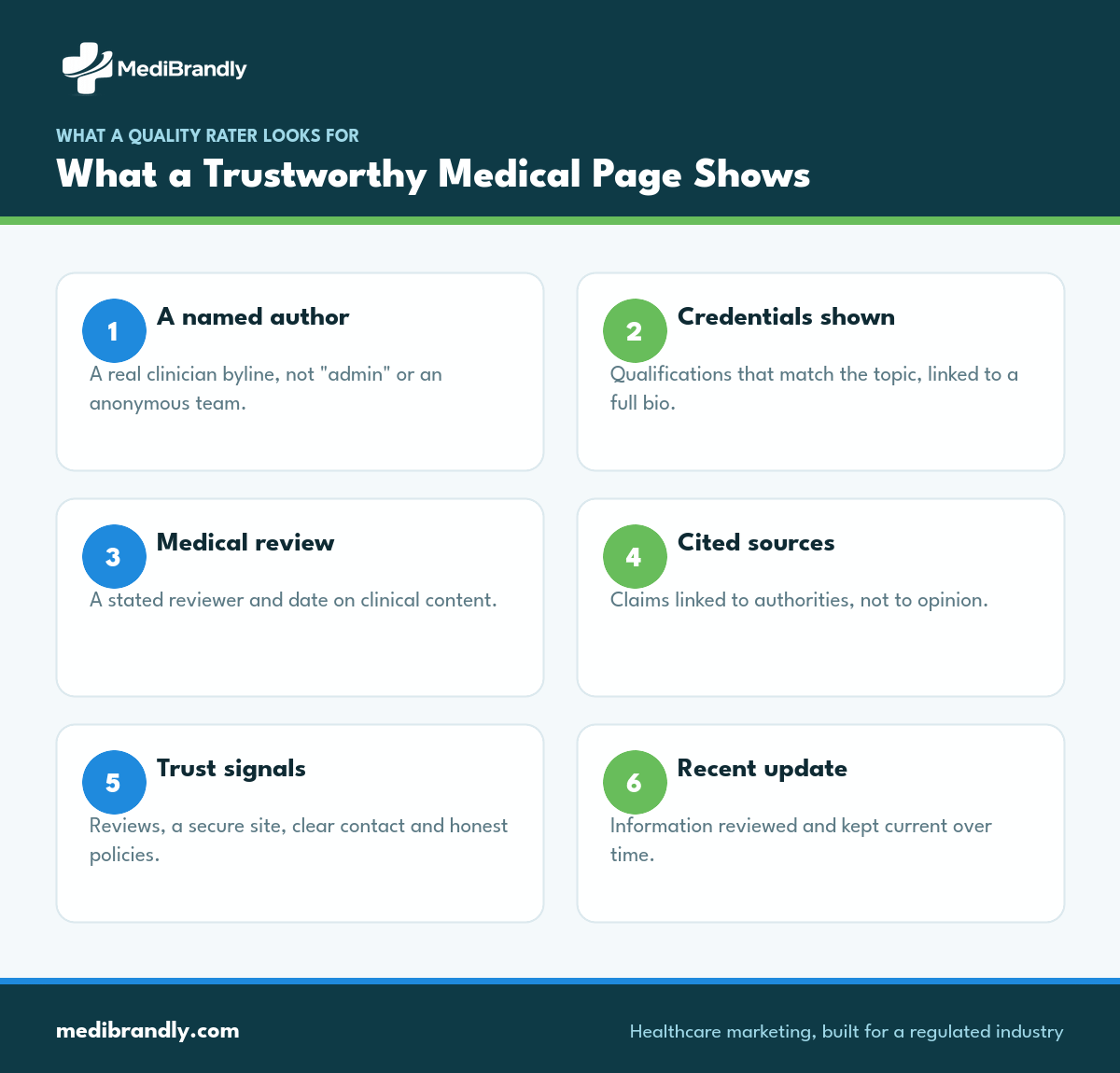
Make expertise and accountability visible on every page: named authors with real credentials, medical review, primary-source citations, and clear trust signals. The goal is to leave no doubt about who stands behind the content and why they can be trusted.
Work through this checklist:
- Named authors with credentials — real clinicians, not “admin” or an anonymous team.
- Medical review — a stated reviewer and date for clinical content.
- Primary-source citations — link claims to authorities like NIH and government health bodies, not to opinion.
- Detailed about and provider pages — bios, qualifications, and photos that establish expertise.
- Trust signals — reviews, a secure site, clear contact information, and honest policies.
- Physician and organization schema — structured data that ties content to credentialed people and a real entity.
- Accuracy and freshness — correct information, reviewed and updated over time.
This is the same author-and-entity work behind our healthcare branding and the structured-data foundation of our healthcare SEO services.
How Does Author Identity Affect Rankings?
A named, credentialed author with a real, verifiable presence signals accountability, which is central to trust — anonymous content struggles precisely because no one stands behind it. For medical topics, who says something matters as much as what’s said.
That means real bylines linked to detailed bios, credentials that match the topic, and a consistent identity across the site and the web. It’s why medical review and clear authorship aren’t cosmetic — they’re a direct trust signal to both Google and patients. The same principle drives AI citation: answer engines prefer sources with clear, credentialed authorship, as our AI Overviews guide explains.
How Do You Audit a Site’s E-E-A-T?
Go page by page and ask whether a cautious reader — or a Google rater — could tell who wrote it, why they’re qualified, and whether it can be trusted. If any answer is unclear, that’s the gap to fix.
Check for named authorship and credentials, medical review where appropriate, cited sources, current information, and visible trust signals on every important page. Prioritize your money pages and your most-visited content first. Turning that audit into fixes — authorship, review, citations, schema — is the durable work that lifts a medical site’s rankings and its AI visibility together.
Want your medical content built to win on trust? We implement the authorship, medical review, citations, and schema that make healthcare content rank and get cited. Book a free consultation →
Frequently Asked Questions
What does E-E-A-T mean?
E-E-A-T stands for Experience, Expertise, Authoritativeness, and Trustworthiness — the qualities Google’s Search Quality Rater Guidelines use to judge content. For health topics, trust is weighted most heavily, so medical pages must clearly show who created the content and why it’s credible.
Why is E-E-A-T so important for medical websites?
Medical content is YMYL — “Your Money or Your Life” — which Google evaluates most cautiously because misinformation can cause harm. That raises the bar: being accurate isn’t enough; the page must visibly demonstrate credible, accountable authorship and trustworthy sourcing to rank.
What is YMYL content?
YMYL stands for “Your Money or Your Life” — topics that can affect a person’s health, safety, or finances. Nearly all medical content qualifies, so Google applies stricter E-E-A-T scrutiny, favoring credible, well-sourced, accountable content over anonymous or thin pages.
How do I improve E-E-A-T on my medical site?
Add named authors with real credentials, medical review with dates, primary-source citations, detailed about and provider pages, visible trust signals, and physician and organization schema. Make it unmistakable on every page who stands behind the content and why they can be trusted.
Does author identity affect medical rankings?
Yes. A named, credentialed author with a verifiable presence signals accountability, which is central to trust. Anonymous medical content struggles because no one stands behind it. Real bylines, matching credentials, and consistent identity are direct trust signals to Google and patients.
How does E-E-A-T affect AI citations?
Answer engines apply a similar trust filter, preferring sources with clear, credentialed authorship, cited evidence, and consistent entity signals. The same E-E-A-T work that helps a medical page rank in search also makes it more likely to be cited in AI Overviews and chatbots.
Turn Real Expertise Into Rankings
Your practice already has the experience and expertise Google’s standard is designed to reward. E-E-A-T is about making that credibility visible and verifiable — to search engines, AI answer engines, and the patients deciding whether to trust you.
We’ll audit your content’s trust signals and implement the authorship, review, citations, and schema that win.
Request your free content and E-E-A-T audit → or email info@medibrandly.com. You can also explore healthcare SEO services or read more about our team.