
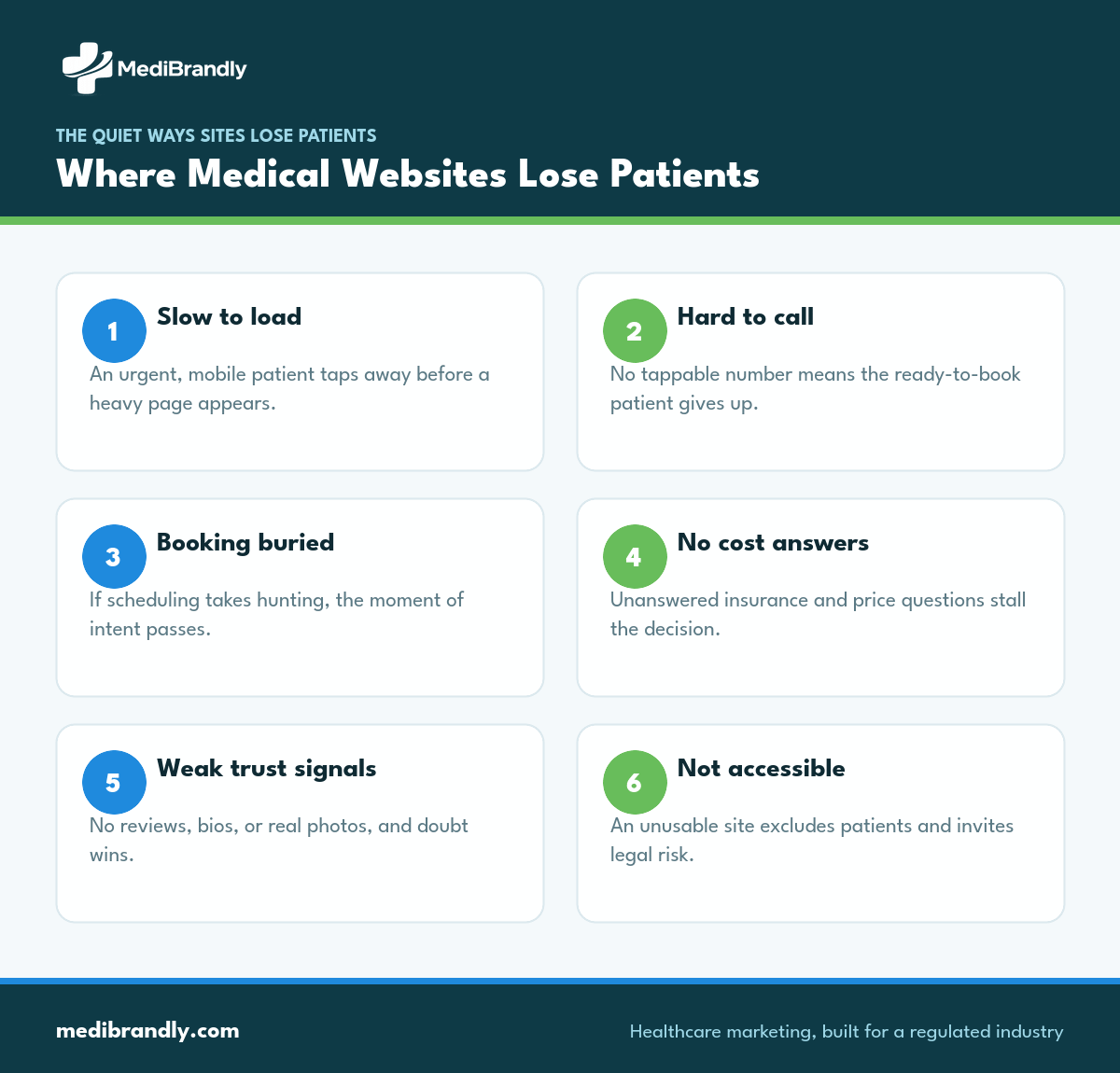
A great healthcare website does three jobs at once: it’s accessible to everyone, it loads fast on a phone, and it turns worried visitors into booked patients. Miss any one and the site quietly costs you appointments — an inaccessible site excludes patients and invites legal risk, a slow one loses them before it loads, and an unclear one lets them leave without booking.
Healthcare web design isn’t about looking modern; it’s about trust, access, and conversion under real constraints. This guide covers the accessibility, speed, and conversion practices that actually matter in 2026.
What Makes a Healthcare Website Effective?
An effective healthcare website is accessible, fast, trustworthy, and easy to book from — in that order of foundation. Design that ignores accessibility or speed undermines everything else, because a patient who can’t use or load the site never sees your polished content.
The best practices that matter most:
- Accessibility to WCAG standards — usable by people with disabilities.
- Fast load on mobile — most healthcare searches happen on a phone.
- Tappable phone number and clear booking above the fold.
- Plain answers to cost and insurance questions patients actually ask.
- Individual service and condition pages, not one “Services” page.
- Named provider bios with credentials and photos.
- Secure, HIPAA-conscious forms for any patient information.
- Real photography of the practice and team.
- Clear trust signals — reviews, credentials, and legal notices.
- Schema markup for organization, provider, and FAQ.
- Simple, obvious navigation to the pages patients need.
- Consistent, accurate contact and location information.
These are the foundations behind our healthcare web design and development work, and the cost of building them in is covered in our medical website cost guide.
Not sure how your site measures up? Request a free website review — we’ll check accessibility, speed, HIPAA-safe forms, and conversion, and tell you exactly what’s costing you appointments.
What Are the Accessibility (ADA/WCAG) Requirements?
The practical standard is WCAG 2.1 Level AA — the benchmark referenced across accessibility frameworks and the one most likely to apply to your practice. Accessibility isn’t optional polish; it’s both a legal consideration and a matter of serving patients with disabilities equally.
| Requirement | What it means in practice |
|---|---|
| Keyboard navigation | Every function usable without a mouse |
| Color contrast | Text readable against its background |
| Descriptive alt text | Images described for screen readers |
| Labeled form fields | Forms usable with assistive technology |
| Visible focus states | Clear indication of where you are on the page |
| Captions on video | Media accessible to deaf and hard-of-hearing users |
The W3C WCAG guidelines define the standard, and the ADA provides the legal backdrop. Building to WCAG 2.1 AA from the start costs far less than retrofitting a finished site, and it widens the audience you can serve. This is general information, not legal advice — confirm your obligations with counsel.
Why Does Site Speed Matter for Medical Websites?
Because healthcare searches are mobile and often urgent, a slow site loses patients before it even appears — and speed is also a ranking factor. Someone looking for care now won’t wait for a heavy page to load; they’ll tap the next result.
Google measures this through Core Web Vitals — loading, interactivity, and visual stability. Optimizing images, limiting heavy scripts, and choosing solid hosting keep a medical site fast on the mid-range phones real patients use. The web.dev resources document how these metrics work, and improving them lifts both conversions and rankings at once. A fast site is the cheapest conversion improvement most practices can make.
How Do You Design a Medical Website That Converts?
Make the next step obvious and effortless at every point a patient is ready to act — a tappable call, a visible booking button, and answers to the questions that stall a decision. Conversion isn’t a trick; it’s removing friction between “interested” and “booked.”
The elements that convert: online scheduling or a tappable phone number above the fold, clear cost and insurance information, reassuring provider bios and real photos, and short, secure forms that don’t demand more than necessary. Every extra click or unanswered question is a chance for an anxious patient to leave. Designing for that moment of readiness is what separates a brochure from a booking engine.
What About HIPAA-Safe Forms and Schema?
Any form that collects patient information must handle it securely, and structured data should describe your practice to search and AI engines. These two technical foundations protect patients and improve visibility respectively, and both are routinely skipped.
Secure forms mean submissions never sit in plain-text email and any vendor handling the data is under a BAA — the most common failure we find. Schema markup for your organization, providers, services, and FAQs helps search and AI engines understand and surface you correctly. Together with your published website legal notices, they make a site both compliant and legible to the systems that send you patients.
Building or fixing a healthcare website? We design accessible, fast, HIPAA-conscious sites built to convert — with the schema and compliance handled as requirements, not upsells. Book a free consultation →
Frequently Asked Questions
What are the most important healthcare website design best practices?
Accessibility to WCAG standards, fast mobile load, a tappable phone number and clear booking above the fold, plain cost and insurance answers, individual service pages, provider bios, secure HIPAA-conscious forms, and schema markup. Accessibility and speed are the foundations everything else builds on.
What accessibility standard should a medical website meet?
WCAG 2.1 Level AA is the practical benchmark, referenced across accessibility frameworks and most likely to apply to your practice. It covers keyboard navigation, color contrast, alt text, labeled forms, focus states, and captions. Building to it from the start is far cheaper than retrofitting.
Why does website speed matter for healthcare?
Healthcare searches are mostly mobile and often urgent, so a slow site loses patients before it loads, and speed is a Google ranking factor. Optimizing images, limiting heavy scripts, and good hosting keep a site fast — one of the cheapest conversion improvements a practice can make.
How do I make a medical website convert more patients?
Make the next step effortless: online scheduling or a tappable phone number above the fold, clear cost and insurance information, reassuring provider bios and real photos, and short secure forms. Remove every unnecessary click or unanswered question between interest and booking.
Do healthcare website forms need to be HIPAA-compliant?
If a form collects patient information, yes. Submissions must be handled securely — never sitting in plain-text email — and any vendor processing the data needs a business associate agreement. Insecure form handling is one of the most common compliance failures on practice websites.
What schema should a healthcare website use?
Structured data for your organization, individual providers, services, and FAQs. It helps search engines and AI answer engines understand and correctly surface your practice, reinforcing the same entity and trust signals that improve both rankings and AI citations.
Build a Site That’s Accessible, Fast, and Booked
A healthcare website earns its keep when everyone can use it, it loads instantly on a phone, and it makes booking effortless. Everything else is decoration.
We’ll review your site against accessibility, speed, HIPAA-safe handling, and conversion, then tell you honestly what to fix first.
Request your free website review → or email info@medibrandly.com. You can also explore web design and development or see our case studies.