
The veterinary clinics that grow profitably in 2026 don’t win on price — they win on being easy to find, easy to trust, and impossible to forget. Discounting trains pet owners to shop around; local visibility, reminders, and genuine relationships build a practice that fills its own schedule.
New clients are worth far more than a single visit, so the goal isn’t a cheap first appointment — it’s a loyal pet owner for the animal’s lifetime. This guide covers the economics, the local SEO, and the retention systems that grow a clinic without eroding its margins.
Why Discounting Is the Wrong Growth Strategy for Vets
Discounts attract price-sensitive, one-time clients and quietly devalue your care — the opposite of what a veterinary practice needs. A new client’s real value is measured across years of wellness visits, dental work, and eventual senior care, not the first appointment’s fee.
When you compete on price, you attract owners who’ll leave for the next coupon and you compress the margins that fund good medicine and good staff. Growing on visibility, trust, and retention instead brings owners who value your care and stay. That’s the model behind our veterinary marketing work, and it mirrors the recall-driven approach we use in dental marketing.
| Discount-driven growth | Loyalty-driven growth | |
|---|---|---|
| Client type | Price shoppers, one-time visits | Committed, long-term clients |
| Margin | Compressed | Protected |
| Retention | Low — they leave for the next deal | High — they stay for the pet’s life |
| Lifetime value | Low | High |
| Effect on brand | Cheapens your care | Reinforces your quality |
Growing on discounts and feeling the margin squeeze? Request a free veterinary marketing audit — we’ll show you where your new clients come from, what each is really worth, and how to grow without cutting prices.
What Is a New Veterinary Client Actually Worth?
A new client’s value is the sum of every visit their pet will make — routine wellness, vaccinations, dental, illness, and senior care — often over a decade or more. Viewed that way, spending to acquire a good long-term client is an investment, not a cost, and a first-visit discount is a poor way to make it.
Understanding this number changes how you market:
- Set an acquisition budget based on lifetime value, not first-visit revenue.
- Prioritize retention — a kept client is far cheaper than a new one.
- Invest in the relationship early, because loyalty compounds over the pet’s life.
- Measure by clients retained, not just new clients booked.
How Do Veterinary Clinics Rank in Local Search?
Pet owners search locally — “vet near me,” “emergency vet,” their town plus the service — so local SEO is the front door to new clients. A complete Google Business Profile, consistent listings, and strong reviews decide who appears when an owner needs care now.
The essentials are the same fundamentals that work for any local practice:
- An optimized Google Business Profile with correct services, hours, and photos.
- Local ranking for “vet near me” and service-specific searches.
- A steady flow of recent reviews, which weigh heavily for anxious pet owners.
- A clear website covering services, new-client info, and after-hours guidance.
The full local playbook is in our local SEO guide, and the compliant, consistent review process is in our guide to getting more Google reviews — both apply directly to veterinary practices.
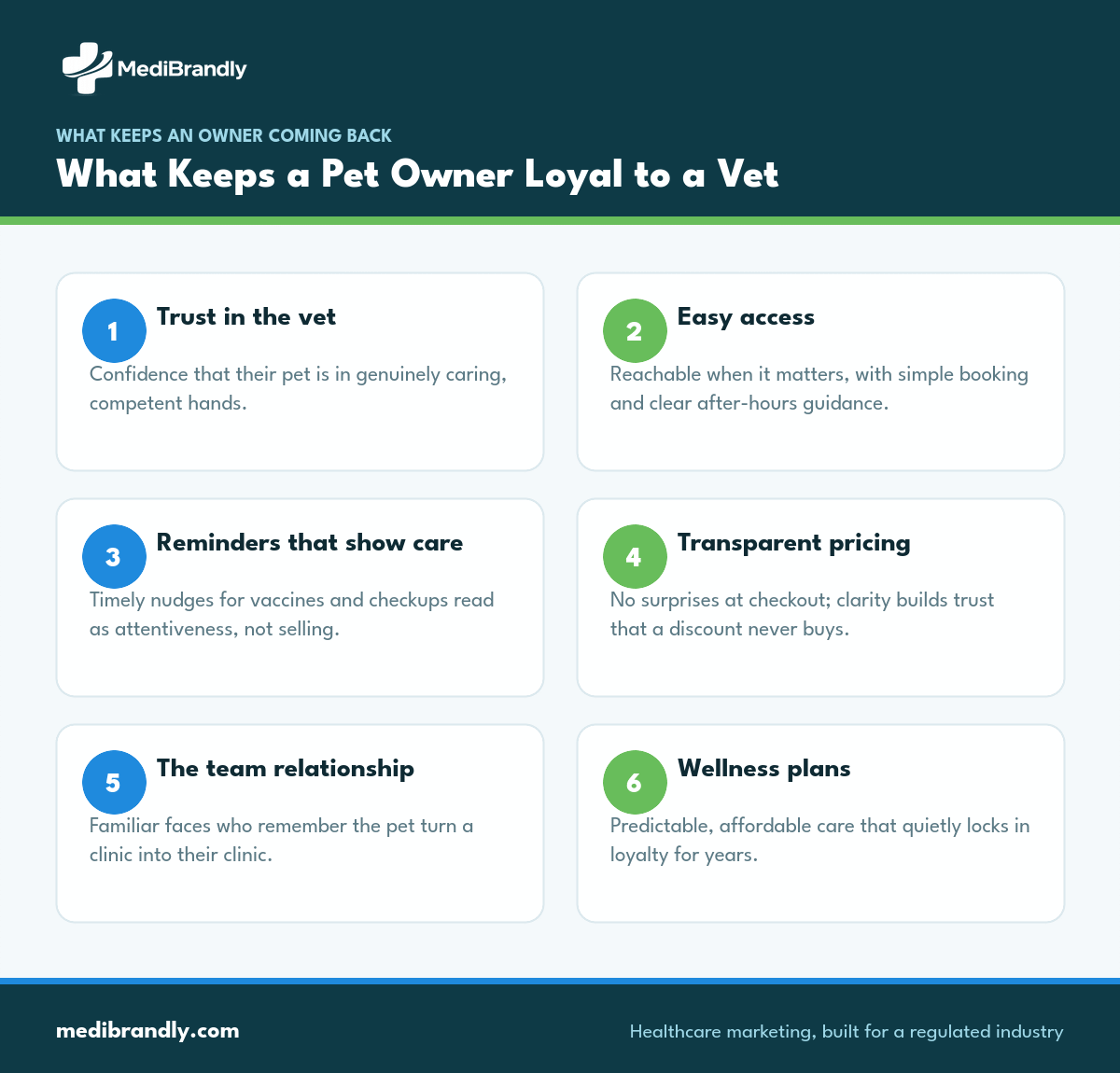
How Does Recall and Reminder Automation Grow a Clinic?
Automated reminders for vaccinations, wellness checks, and dental care bring existing clients back on schedule — the cheapest, most reliable growth a clinic has. Pet owners genuinely want to do right by their animals; they simply forget, and a timely reminder is a service, not a sales pitch.
Automated recall does three things at once: it fills the schedule with already-loyal clients, it improves the pet’s health outcomes, and it signals that your clinic pays attention. Running it reliably — by each pet’s due dates and the owner’s preferred channel — is a job for automation, and it’s the core of our email marketing and automation work. Most clinics leave more revenue in un-sent reminders than in any new-client campaign.
What Social Content Works for Veterinary Practices?
Content that celebrates pets and builds trust — not content that tries to go viral. Pet owners follow clinics for reassurance, education, and the occasional heart-melting patient photo, and that familiarity is what makes them choose and stay with you.
What works:
- Patient photos (with the owner’s permission) that show the care and the joy.
- Plain-language pet-health education answering what owners search and worry about.
- Team and behind-the-scenes content that makes a nervous owner comfortable.
- Seasonal reminders — parasite season, holiday hazards, dental month.
This steady, reassuring presence is low-drama and high-trust, exactly the kind of program that keeps a clinic top of mind between visits.
How Do Wellness Plans Support Growth?
Wellness plans turn one-time visits into predictable, recurring relationships — spreading preventive care into monthly payments that improve compliance and loyalty at once. For the owner, care becomes affordable and automatic; for the clinic, revenue becomes predictable and clients stay.
Marketing a wellness plan well means explaining the value simply — what’s included, what it saves, how it keeps their pet healthier — and making enrollment easy at the visit and online. It’s a far healthier growth lever than discounting, because it deepens the relationship instead of cheapening it, and it pairs naturally with the recall automation that keeps enrolled pets on schedule.
Want to grow your clinic without racing to the bottom on price? We build the local visibility, review, recall, and wellness-plan systems that grow veterinary practices on loyalty, not discounts. Book a free consultation →
Frequently Asked Questions
How do veterinary clinics get more clients?
By being easy to find in local search, earning consistent reviews, and reactivating existing clients through automated reminders — not by discounting. New clients found on visibility and trust stay longer and are worth far more than coupon-driven, one-time visitors.
Why is discounting bad for veterinary practices?
Discounts attract price-sensitive clients who leave for the next deal, and they compress the margins that fund quality care and staff. Because a client’s real value spans years of visits, competing on price undercuts the long-term relationship that actually drives profit.
How much is a new veterinary client worth?
A new client’s value is the sum of every visit their pet makes over its life — wellness, dental, illness, and senior care — often a decade or more. That lifetime value, not the first-visit fee, should guide how much you invest to acquire and keep them.
How do vets rank higher on Google?
With a complete, optimized Google Business Profile, consistent local listings, a steady flow of recent reviews, and a clear website covering services and new-client information. Pet owners search locally and urgently, so local SEO and reputation decide who they call.
Do reminder systems really increase revenue?
Yes, often more than any new-client campaign. Automated reminders for vaccinations, wellness, and dental care bring loyal clients back on schedule, improving both pet health and clinic revenue. Most practices leave significant income in reminders they never send.
Are wellness plans worth offering?
For most clinics, yes. Wellness plans make preventive care affordable and automatic for owners while giving the practice predictable, recurring revenue and stronger loyalty. They grow a clinic by deepening relationships rather than discounting care.
Grow on Loyalty, Not Discounts
The strongest veterinary practices don’t compete on price — they’re the easiest to find, the easiest to trust, and the best at bringing pets back for the care they need. That’s a system, and it’s one you can build.
We’ll audit where your clients come from, what they’re worth, and where you’re leaking loyalty, then build the local-SEO, review, recall, and wellness-plan engine that grows your clinic profitably.
Request your free veterinary marketing audit → or email info@medibrandly.com. You can also explore veterinary marketing or see results in our case studies.