
Healthcare marketing is the practice of attracting, informing, and retaining patients for medical providers and health brands — within strict privacy, advertising, and trust rules that general marketing doesn’t face. It spans SEO, paid media, web, content, reputation, CRM, and analytics, all measured in booked appointments rather than clicks.
Because health decisions are high-stakes and heavily regulated, healthcare marketing is its own discipline. This guide explains what it is, how it differs from ordinary marketing, the channels involved, and how patients actually move from a question to a booked visit.
How Is Healthcare Marketing Different From Regular Marketing?
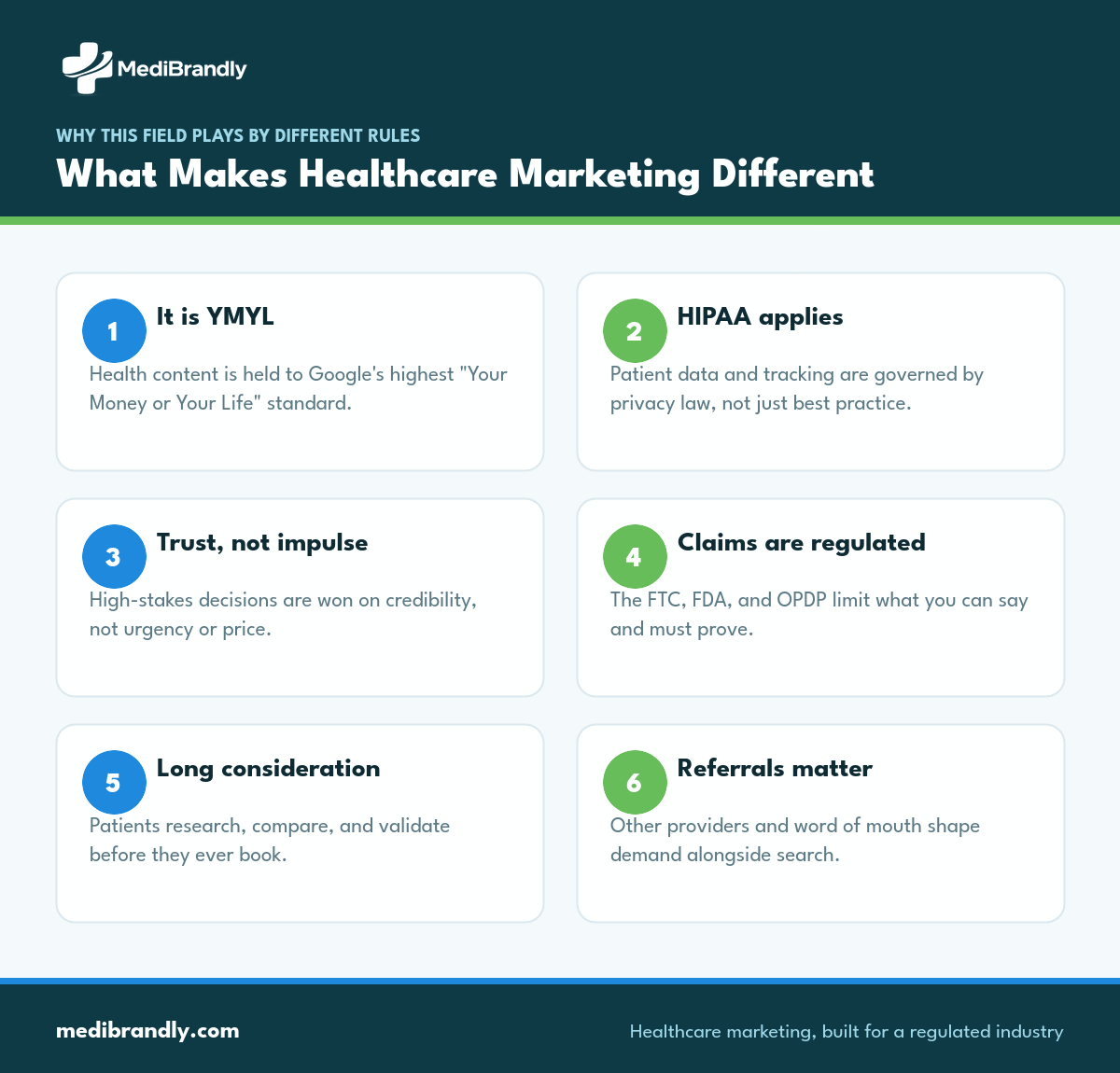
It operates under three constraints ordinary marketing ignores: it’s YMYL (“Your Money or Your Life”) content Google holds to a higher standard, it’s bound by HIPAA and advertising rules, and it sells trust for high-stakes decisions rather than impulse purchases. Those constraints change every tactic.
You can’t test wild claims, you can’t track patients the way e-commerce tracks shoppers, and you can’t win on price or urgency alone. Instead you win on credibility, clarity, and being genuinely helpful when someone is worried. A general agency that treats a medical practice like a retail brand tends to create both compliance risk and weak results. This is why specialization matters, and it’s the premise of everything in our healthcare marketing services.
New to healthcare marketing and not sure where to start? Book a free strategy consultation — we’ll explain what applies to your specialty, what doesn’t, and the two or three moves that would grow your practice fastest.
What Are the Main Channels of Healthcare Marketing?
Healthcare marketing works as a system of channels that reinforce each other — no single one fills a practice. Each does a specific job in moving a patient from unaware to booked, and the strongest programs coordinate them rather than chasing one in isolation.
| Channel | What it does | MediBrandly service |
|---|---|---|
| SEO & local search | Gets you found when patients search | Healthcare SEO |
| Paid search & PPC | Captures urgent, high-intent demand now | Paid search & PPC |
| Web design | Converts visitors into booked patients | Web design & development |
| Content & AEO | Answers questions and earns AI citations | See our AI Overviews guide |
| Social media | Builds trust and familiarity | Social media marketing |
| Email & automation | Nurtures and reactivates patients | Email & automation |
| CRM | Captures and follows up every inquiry | CRM & automation |
| Analytics | Proves what drives booked patients | Analytics & reporting |
The channels compound: SEO and content earn attention, the website and reputation convert it, and CRM plus analytics make sure nothing leaks and everything is measurable.
What Does the Patient Journey Look Like?
Patients move through predictable stages — from a question, to comparing options, to validating a choice, to booking, to staying. Marketing’s job is to be present and persuasive at each stage, because a patient lost at any step is a patient gone.
- Research — a symptom or need sends them searching, increasingly inside AI answers.
- Comparison — they shortlist a few providers from maps, reviews, and who got cited.
- Validation — they check credentials, reviews, and real photos for reassurance.
- Access — whoever is easiest to reach and book, soonest, usually wins.
- Retention — recall and follow-up decide whether one visit becomes a relationship.
Mapping your marketing to these stages is covered in depth in our patient acquisition guide, and the stages apply across every specialty on our healthcare specialties roster.
What Rules Govern Healthcare Marketing?
Several frameworks apply at once: HIPAA governs patient data and tracking, the FTC governs claims and reviews, and the FDA and OPDP govern pharmaceutical and device promotion. Ignoring them creates real legal and financial risk, not just a marketing setback.
In practice this means secure forms, tracking that never leaks patient data to ad platforms, honest and substantiated claims, compliant review practices, and careful language around outcomes. The rules aren’t a reason to market timidly — they’re the foundation that makes healthcare marketing credible. The specifics for online tracking and reviews are in our HIPAA marketing rules guide.
How Does a Practice Get Started?
Start with the foundations — a findable, bookable presence — then layer on the channels that fit your specialty and goals. Trying to do everything at once scatters effort; sequencing it produces compounding results.
The sensible order is the one that mirrors the patient journey: be found (local SEO and a strong site), be chosen (reviews and clear information), be booked (easy scheduling and fast follow-up), and be measured (analytics from day one). From there, paid search adds immediate volume and content builds long-term authority. If you’d like that sequence mapped to your situation, that’s exactly what a strategy and consulting conversation is for.
Want a clear plan for your specialty? We turn the whole picture — channels, journey, and compliance — into a prioritized plan built around booked appointments. Book a free consultation →
Frequently Asked Questions
What is healthcare marketing?
Healthcare marketing is attracting, informing, and retaining patients for medical providers and health brands, within strict privacy, advertising, and trust rules. It spans SEO, paid media, web, content, reputation, CRM, and analytics, and is measured in booked appointments rather than clicks or impressions.
How is healthcare marketing different from regular marketing?
It operates under three constraints ordinary marketing ignores: YMYL content Google holds to a higher standard, HIPAA and advertising rules, and high-stakes decisions won on trust rather than impulse. These change every tactic, which is why healthcare marketing is a specialized discipline.
What are the main channels of healthcare marketing?
SEO and local search, paid search, web design, content and AEO, social media, email and automation, CRM, and analytics. They work as a coordinated system — attention, conversion, follow-up, and measurement — rather than as isolated tactics, and no single channel fills a practice alone.
What rules govern healthcare marketing?
HIPAA governs patient data and tracking, the FTC governs claims and reviews, and the FDA and OPDP govern pharmaceutical and device promotion. Compliance means secure forms, privacy-safe tracking, honest substantiated claims, and compliant review practices — the foundation of credible healthcare marketing.
How much does healthcare marketing cost?
It ranges widely by services, specialty, and market, from a few thousand to tens of thousands of dollars a month. The figure that matters is cost per acquired patient, not the retainer. Our healthcare marketing cost guide breaks down real pricing by channel.
How do I start marketing my healthcare practice?
Begin with foundations — a findable, bookable website and local presence — then add reviews, easy scheduling, and measurement, and layer paid search and content over time. Sequencing the work to mirror the patient journey produces compounding results rather than scattered effort.
Understand It, Then Put It to Work
Healthcare marketing isn’t ordinary marketing with a stethoscope added — it’s a distinct discipline built on trust, compliance, and being genuinely useful to patients making important decisions.
We’ll help you understand what applies to your specialty and turn it into a prioritized plan that grows your practice, compliantly.
Book your free strategy consultation → or email info@medibrandly.com. You can also explore all our healthcare marketing services or browse by specialty.