
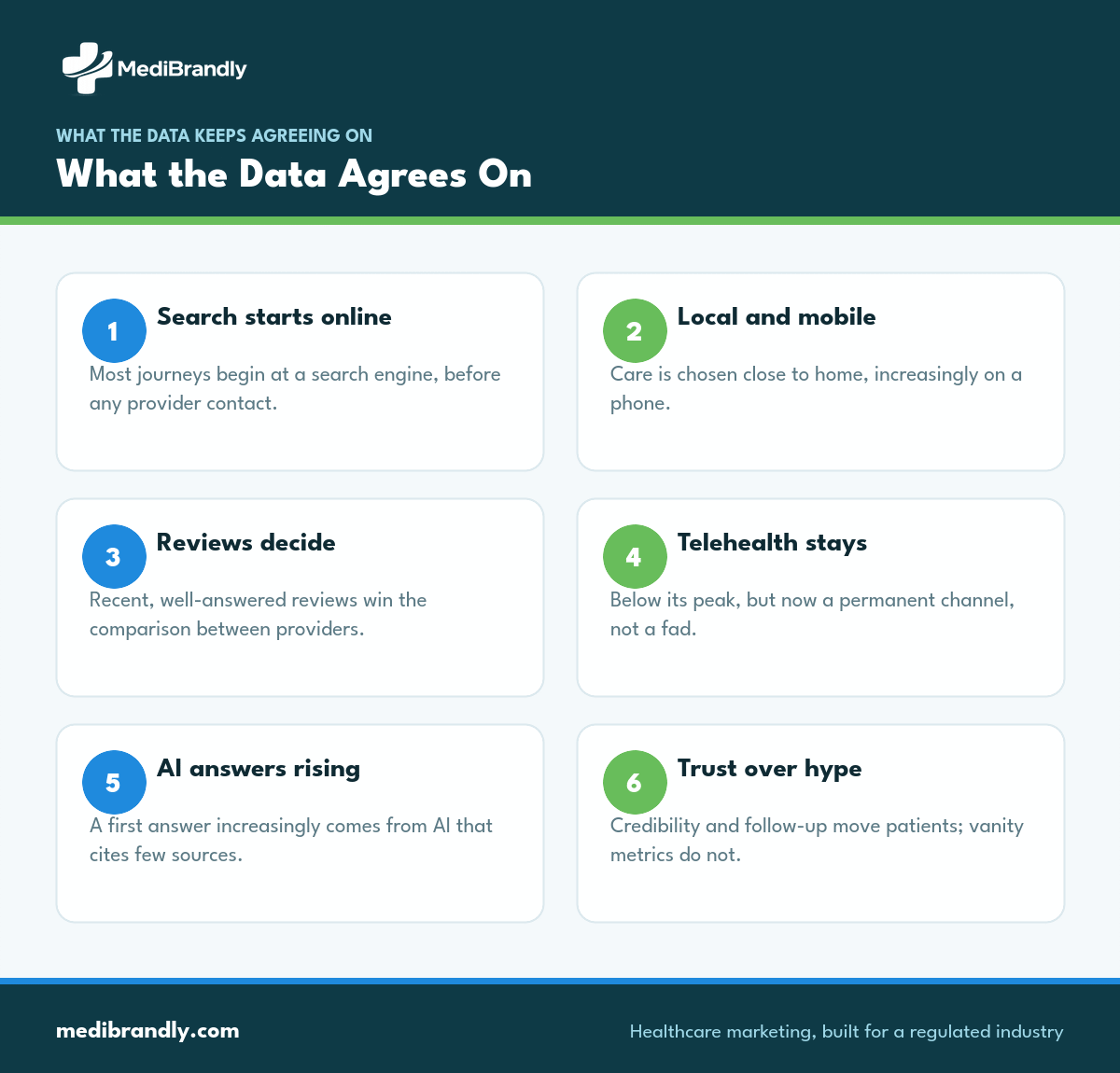
The single most important pattern in the data is consistent across two decades of research: most people begin their search for care online, at a search engine, before they ever contact a provider. How they search has changed — mobile, reviews, and now AI answers — but the starting point hasn’t.
A note on honesty up front: this page cites verified figures to their primary source and year, and uses clearly-framed benchmark ranges where no authoritative current figure exists. We don’t publish invented percentages — a standard we hold our clients’ content to as well.
How Do Patients Search for Care?
Online search is where the healthcare journey begins, and it starts at a general search engine far more often than at a specialized health site. That single behavior is why local SEO and being cited in search and AI answers matter so much.
- In Pew Research Center’s foundational work on the subject, roughly eight in ten internet users reported looking online for health information, and 77% of those health seekers began at a search engine rather than a specialized health site (Pew Research Center, Health Online 2013).
- Health seekers have long divided their searches between their own situation and someone else’s — roughly a third each, with the rest doing both (Pew Research Center).
- Mobile has become the dominant entry point: healthcare “near me” searching is now overwhelmingly a smartphone behavior, which is why site speed and a tappable phone number are non-negotiable.
The durable takeaway: whoever is most findable and credible at the search-engine and AI-answer stage wins the first, decisive moment. The mechanics are in our guide to getting cited in Google AI Overviews.
Want to know how your practice shows up when patients search? Request a free visibility audit — we’ll check your local search, reviews, and AI-answer presence, and show you where you’re invisible at the moment patients decide.
What Does the Telehealth Data Show?
Telehealth surged during the pandemic and has settled into a lower but still substantial level of use. It’s now a permanent channel, not a temporary one, especially for behavioral health and follow-up care.
| Telehealth metric | Figure | Source |
|---|---|---|
| Office-based physicians using telemedicine, 2024 | 80.0% (down from 86.5% in 2021) | CDC / NCHS |
| Adult telemedicine use by sex, 2021 | 42.0% women, 31.7% men | CDC / NCHS |
| Use in non-metro areas, 2021→2024 | Declined from 83.3% to 60.9% (physicians) | CDC / NCHS |
For virtual-care brands, the implication is that demand is real but no longer automatic — acquisition and multi-state visibility matter more than they did at the peak, as covered in our telehealth marketing guide.
How Much Do Reviews and Reputation Matter?
Online reviews are consistently among the most influential factors when patients choose a provider — and recency and volume both weigh in. While precise, authoritative national figures are scarce, the direction is unambiguous across the research and in what practices see every day.
- The majority of patients consult online reviews before choosing a new provider, and a practice with recent, well-answered reviews typically wins the comparison against one with a stale or thin profile.
- Review recency commonly matters as much as total count: an active stream signals a currently-trusted practice.
- Responding to reviews — compliantly, without confirming patient status — typically improves how both prospective patients and local search perceive a practice.
The compliant way to build this is in our guide to getting more Google reviews.
What About Local Search and the Map Pack?
Local search drives a large share of new-patient contact, because most care is chosen close to home. The map pack — the top local results with a map — captures a disproportionate share of clicks and calls for “near me” and location-based health searches.
- Local, high-intent searches (a service plus a location, or “near me”) commonly convert to a call or visit quickly, often the same day.
- Appearing in the local map pack typically produces more direct calls and direction requests than any single organic listing below it.
- Consistency of your name, address, and phone across the web is a well-established local ranking factor.
The full local playbook is in our local SEO guide for doctors.
What Do Paid Search Benchmarks Look Like?
Healthcare is among the more expensive categories for paid search, because the value of a patient is high and competition is intense. Exact costs vary widely by specialty and market, so these are framed as ranges, not fixed figures.
- Cost per click and cost per lead in healthcare typically run higher than in most consumer categories, with elective and high-value specialties (cosmetic, addiction treatment, some surgical) commanding the highest costs.
- The return depends far more on conversion and follow-up than on click price — a lower cost per click means little if inquiries aren’t booked.
Real pricing by channel is broken down in our healthcare marketing cost guide.
What’s Changing With AI Search?
The newest and fastest-moving shift is patients receiving answers directly from AI, often before visiting any website. Authoritative long-run statistics are still emerging, so this is best understood directionally rather than through precise figures.
- A growing share of health queries now surface an AI-generated answer that names only a few sources, making being cited the new competitive goal.
- Practices with clear, credentialed, well-structured content are the ones AI answer engines tend to cite, echoing the same E-E-A-T signals covered in our E-E-A-T guide.
Methodology Note
Every specific figure on this page is cited to its primary source (Pew Research Center or the CDC’s National Center for Health Statistics) with the year of the data, so you can verify it. Where no authoritative current figure exists — common for fast-moving marketing metrics like review influence or AI adoption — we use clearly-framed benchmark language (“typically,” “commonly,” “the majority”) rather than inventing precise percentages. That’s the same standard we apply to client content, because in healthcare a fabricated statistic is both a trust risk and a compliance risk.
Want data-backed marketing built on real numbers, not made-up ones? We build healthcare marketing measured with honest attribution and reported transparently. Book a free consultation →
Frequently Asked Questions
Where do most patients start their search for care?
Most begin online at a general search engine rather than a specialized health site — Pew Research found 77% of online health seekers started at a search engine. That first moment, now increasingly an AI answer, is where being findable and credible matters most.
How many people look online for health information?
In Pew Research Center’s foundational research, roughly eight in ten internet users reported looking online for health information. Search engines are the dominant starting point, which is why local SEO and AI-answer visibility are central to reaching patients early in their journey.
Is telehealth still widely used in 2026?
Yes, though below its pandemic peak. CDC data shows 80.0% of office-based physicians used telemedicine in 2024, down from 86.5% in 2021. Telehealth is now a permanent channel, especially for behavioral health and follow-up care, so virtual-care marketing remains important.
Do online reviews really affect which provider patients choose?
Consistently, yes. The majority of patients consult reviews before choosing a provider, and recency and volume both matter. A practice with recent, well-answered reviews typically wins the comparison. Authoritative precise national figures are scarce, but the direction is unambiguous.
Why are healthcare paid search costs so high?
Because a patient’s value is high and competition is intense, healthcare typically has higher cost per click and cost per lead than most categories, with elective and high-value specialties the most expensive. Return depends more on conversion and follow-up than on click price.
Why doesn’t this page list dozens of exact percentages?
Because we won’t publish figures we can’t attribute to a credible source. We cite verified primary-source statistics with their year and use clearly-framed ranges elsewhere. In healthcare, an invented statistic is a trust and compliance risk, so accuracy comes before an impressive-looking number.
Market on Real Numbers, Not Invented Ones
The data that matters is consistent: patients start online, search locally, weigh reviews, and increasingly get their first answer from AI. The practices that grow build around those durable realities and measure honestly.
We’ll help you act on the data that applies to your specialty and measure your marketing with attribution you can trust.
Request your free visibility audit → or email info@medibrandly.com. You can also explore all our healthcare marketing services or read our 2026 trends guide.