
The modern healthcare funnel has five stages: research, comparison, validation, access, and retention — and in 2026 it increasingly begins inside an AI answer, not a search results page. A patient can drop out at any stage, so the practices that grow are the ones present and persuasive at every step, not just the first.
Most practices pour effort into attracting attention and then leak patients at the stages they never mapped. This guide walks the whole funnel, the content and metrics for each stage, and where the leaks usually are.
What Are the Stages of the Healthcare Marketing Funnel?
The five stages take a person from a symptom or need to a booked, retained patient — each with a different question in mind and a different job for your marketing. Understanding what the patient is doing at each stage is what lets you meet them with the right thing.
| Stage | What the patient is doing | Marketing’s job |
|---|---|---|
| Research | Exploring a symptom or need, often in AI answers | Be the cited, credible source |
| Comparison | Shortlisting providers from maps and reviews | Win the local pack and reputation |
| Validation | Checking credentials, reviews, and photos | Reassure with proof and trust signals |
| Access | Trying to book with the least friction | Make booking effortless and fast |
| Retention | Deciding whether to return | Recall, follow-up, and relationship |
The funnel isn’t linear anymore — patients loop back, compare mid-way, and validate constantly — but these five jobs still have to be done. It’s the practical shape of the patient journey every specialty shares.
Not sure where your funnel leaks? Request a free funnel audit — we’ll trace how patients move from first search to booked visit for your practice, and pinpoint exactly where you’re losing them.
What Content Works at Each Stage?
Each stage needs a different kind of content, because the patient’s question changes as they move. Answer-first, credible content early; reassurance and proof in the middle; friction-free booking at the end.
- Research — answer-first educational content structured for AI citation.
- Comparison — a strong Google Business Profile, reviews, and clear service pages.
- Validation — provider bios, credentials, real photos, and trust signals.
- Access — online scheduling, tappable calling, and fast inquiry response.
- Retention — recall campaigns, follow-up, and helpful ongoing communication.
Matching content to stage is what turns a scattered set of tactics into a funnel. The early-stage AI-citation work is in our AI Overviews guide, and the retention stage runs on email and automation.
Where Do Practices Leak Patients?
Everywhere they haven’t deliberately built the funnel — most often at validation, access, and retention, the stages that come after the marketing everyone focuses on. A practice can rank well and still lose patients to a slow booking process or an unanswered call.
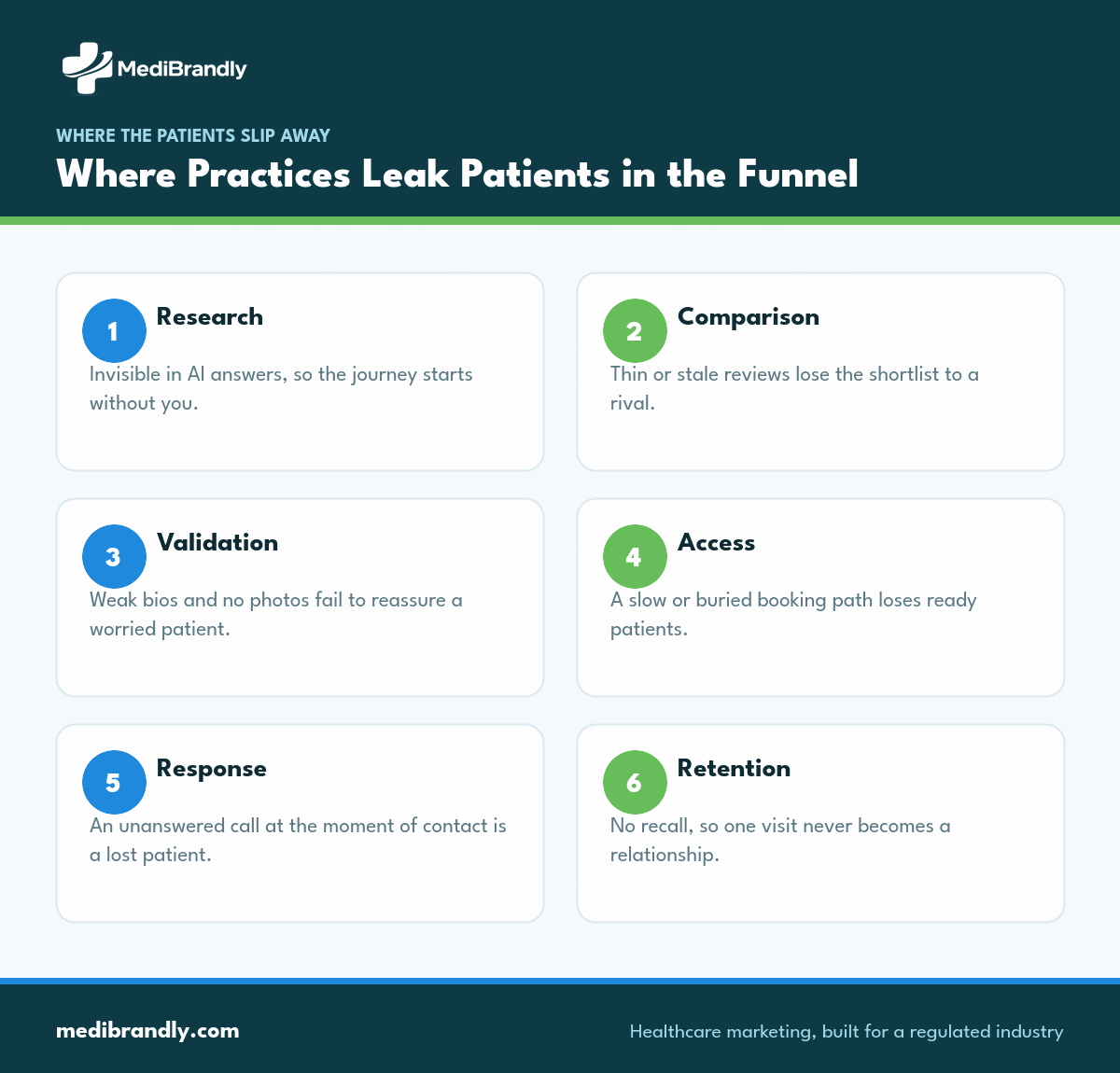
The common leaks: being invisible in AI answers at research, thin reviews at comparison, weak provider bios at validation, a slow or buried booking path at access, an unanswered phone at the moment of contact, and no recall at retention. Each is fixable, and each fix recovers patients you already paid to attract. Finding them is what a funnel audit does; fixing the follow-up ones is where a CRM and marketing automation system earns its keep.
How Do You Measure the Funnel?
Measure the movement between stages, not just the top — impressions and clicks tell you nothing if patients leak before booking. The goal is to see where people drop so you can fix the specific stage, not guess.
Track visibility and citations at research, map-pack presence and reviews at comparison, engagement and inquiries at validation and access, and booked-and-kept appointments plus reactivation at retention. Connecting these — compliantly, without exposing patient identity — turns the funnel from a metaphor into a managed system. That end-to-end measurement is the job of analytics and reporting, and it’s what tells you which fix will recover the most patients.
What Role Does CRM Play Across the Funnel?
A CRM is the connective tissue of the funnel — it captures every inquiry, ensures follow-up, and drives the retention stage most practices neglect. Without it, patients fall through the gaps between attraction and booking that no one is watching.
The CRM makes sure a form or call is logged, routed, and answered fast at access; it automates the recall and reactivation that power retention; and it feeds the attribution that measures the whole funnel. It’s the difference between a funnel you hope is working and one you can see and manage. For most practices, plugging the follow-up and retention leaks returns more than any new top-of-funnel campaign — the same lesson in our patient acquisition guide.
Want your whole funnel working, not just the top? We map, measure, and fix the healthcare marketing funnel end to end — so you stop leaking the patients you already attract. Book a free consultation →
Frequently Asked Questions
What is the healthcare marketing funnel?
It’s the path a patient takes from first need to booked, retained visit, in five stages: research, comparison, validation, access, and retention. In 2026 it often begins inside an AI answer. Marketing’s job is to be present and persuasive at each stage, since patients can drop out at any point.
What are the stages of the patient journey?
Research (exploring a need, often in AI answers), comparison (shortlisting providers), validation (checking credentials and reviews), access (booking with least friction), and retention (deciding whether to return). Each stage has a different patient question and a different job for your marketing.
Where do practices lose the most patients?
Usually at validation, access, and retention — the stages after the attraction most practices focus on. Weak bios, a slow or buried booking path, unanswered calls, and no recall all leak patients a practice already paid to attract. These post-click stages are the cheapest to fix.
What content works at each funnel stage?
Answer-first educational content for research, a strong Google Business Profile and reviews for comparison, provider bios and trust signals for validation, effortless booking for access, and recall and follow-up for retention. Matching content to stage turns scattered tactics into a working funnel.
How do you measure a healthcare marketing funnel?
Measure movement between stages, not just the top: visibility and citations at research, map-pack presence and reviews at comparison, inquiries at validation and access, and booked, kept, and reactivated appointments at retention — connected compliantly, without exposing patient identity.
What role does a CRM play in the funnel?
The CRM is the connective tissue: it captures and routes every inquiry, ensures fast follow-up at booking, automates recall and reactivation for retention, and feeds the attribution that measures the whole funnel. It’s what turns a hoped-for funnel into a managed, measurable system.
Stop Leaking the Patients You Already Attract
Most practices don’t have an attraction problem — they have a funnel problem, losing patients at the validation, access, and retention stages nobody mapped. Fix those and you grow without spending a dollar more on traffic.
We’ll map your funnel end to end, find the leaks, and build the system that carries patients from first search to booked, returning visit.
Request your free funnel audit → or email info@medibrandly.com. You can also explore CRM and marketing automation or see results in our case studies.